- UKULELE REVIEWS
- UKULELE CHORD CHART and FRETBOARD PAGE
- UKULELE BEGINNERS TIPS
- UKULELE SONG TAB and CHORDS
- UKULELE CLUBS AND SOCIETIES
- UKULELE TUITION
- UKULELE BEGINNERS VIDEOS
- UKULELE FESTIVAL CALENDAR
- UKULELE STORES
- UKULELE GLOSSARY
- UKULELE RANTS
- GOT A UKULELE MERCH
- UKULELE LUTHIERS and HAND MADE BUILDERS
- UKULELE ACTS FOR HIRE
- INTERVIEWS
- PRIVACY
- CONTACT ME / ABOUT ME / PRESS
SEARCH GOT A UKULELE
Want To Say Thank You?
Showing posts with label mahalo. Show all posts
26 Jul 2025
14 Jan 2023
14 Jan 2023T15:12
Read More »
Mahalo Hano Concert Ukulele - REVIEW
Returning this week to a ukulele brand that was actually my first foray with the instrument (for better or worse). This is the Mahalo Hano Concert.
5 Jun 2022
5 Jun 2022T14:49
Read More »
Mahalo Pearl MP3 Tenor Ukulele - REVIEW
A somewhat unexpected return for Mahalo on Got A Ukulele this week - this is their MP3 Pearl Tenor Ukulele.
4 Jun 2016
4 Jun 2016T13:40
This one also goes under the less glitzy name of the Mahalo U/LTD2/G ukulele, and what all that stands for I have NO idea. I'm told that it's a Limited Edition (no idea what makes it Limited - it's readily available in loads of stores), but the confusion doesn't end there as you will see.
The 2016K is a standard shaped soprano scale instrument, with a double bout, and a fairly flat base. It's also made from a variety of woods.
Firstly we have a solid top made of mahogany. It's hard to tell, but I think it's in two pieces, but the very straight mahogany grain leaves nothing really to bookmatch. Regardless, it's a nice piece of wood and no complaints here. I suppose it's pretty plain on top, but I have a liking for plain looking mahogany sopranos.
Things get more confusing when we go to the back and sides. These are made from laminate wood with an outer veneer. Most dealers suggest that the outer veneer on this is koa, and from the stripe, I can see why. Saying that, the stripe is a little uniform and a check on the Mahalo website says the outer veneer is Malapoga wood. I know very little about malapoga and have never seen it on an instrument, but I believe it's a type of cedar. Answers on a postcard please.... Anyway, whatever it is, it does actually look nice and I do like the stripes. Being laminate of course it wont affect the tone distinctly so perhaps it doesn't matter what it is! If I sound confused though, it's because I am!
The back is very slightly arched and made from two pieces, and the sides are also in two pieces with an inlaid wooden stipe at the base join.
Decoration wise we have a few things and they are not overly blingy. Firstly we have some thin black white black edge binding on the top and back together with some wood edging on the binding too. It's not overly done and I think looks very nice actually. Around the sound hole we have an abalone inlay which doesn't match the binding but again is nicely done. The whole of the body is finished in a satin coat which also tones down the bling and gives it a rather nice tactile finish and look.
Unlike many Mahalos I have looked at, the finish on this one is pretty good actually and I am not spotting any rough patches, drips or bubbles. All ok on this front.
The bridge is a rosewood slotted type and the saddle appears to be NuBone and is compensated to assist with intonation.
Inside the instrument is nice and tidy too, with notched kerfing and no glue blobs. The bracing looks a little chunky to me, including a back brace that is not only overly thick but questionable on a laminate back in any event.
Up to the neck and this is made from 'nato' wood and is finished in the same satin. It's made from three pieces with a joint at the heel and one at the headstock. The heel is also nicely capped with a sliver of mahogany.
Topping the neck is a rosewood fingerboard. It's unbound at the edges, but looks to be in good condition.
We have 12 nickel silver frets and none past the body join. They are actually a little sharp on the edges, but a good store can easily tidy these for you I suppose. We have pearloid position markers at the 5th, 7th and 10th spaces and these are thankfully repeated on the side.
Past the nut, (which appears to be made of plastic and not NuBone like the saddle) and we have a generic crown shaped headstock, complete with a screenprinted Mahalo logo. I said in an earlier review that I think the Mahalo logo looks cheap and old fashioned now and I still think that.
The tuners are a real letdown - the same dolphin shaped brass open gears that adorn so many Mahalo instruments, complete with MASSIVE black plastic buttons. They are grindy to use (some are looser than others) and look, frankly, horrible. I dont like geared tuners on a soprano at the best of times, but if you are going to use them, please dont choose ones with tuning pegs that would fit a guitar. It looks silly and can affect the balance of the instrument.
Completing the deal are (what else) Aquila strings and a rather nicely made padded and branded Mahalo gig bag. And all that for.... £80. So a pretty nice price really.
So as you have probably gathered, this is not what most people think about when they think Mahalo and it is a far cry from the brightly coloured cheap ukuleles that flooded the market in the Mahalo name. It's actually a nice looking solid top instrument for a pretty reasonable price. Is the playability a let down though?
Well, the body is pretty light and comfortable to hold, and that satin finish is nice on the fingers. Sadly it's totally neck heavy on account of those mahoosive tuners. If you try to balance this at the 12th fret the headstock just dips to the ground. More established players wont perhaps notice it, but beginners learning to hold and play the ukulele for the first time will find they fight against it. This would be so easily solved with different tuners.
Setup wise, the action at the saddle is perfectly acceptable. A little high for my liking but within reasonable tolerances and easy to take down. The nut however is cut too high, particularly on the C and E strings, meaning intonation issues at the first and second fret. Whilst the saddle is easily remedied by a beginner, the nut is a more complex job. And there is no point throwing a compensated saddle on an instrument if your setup then undoes all the work on tightening up the intonation..
The sound is actually far better than I imagined it to be, and I will stick my neck out to say it's the nicest sounding Mahalo soprano I have ever played. Volume is just about acceptable, although I would prefer a little more bark and bite from a soprano. Perhaps it's being hampered by that thick bracing. No real punch to it, but it would hold it's own I think.
It's not the sweetest tone in the world and it can get a bit one dimensional when strumming and can get a bit muddy and confused. Sustain isn't too bad, but as a whole it just doesn't really set me alight. Massively better than a lot of the Mahalo stable, and perfectly acceptable as a cheap soprano though.
I also think that it's a shame that Mahalo strode away from the ultra cheap, creating a nice looking instrument with a solid top, but then totally let it down with terrible tuners.
And that I suppose is my main gripe with it. At £80, yes, it's reasonable on the face of it, but I think I would be more pleased with a decent fully laminate instrument from the likes of Kala or Baton Rouge or perhaps a solid topped Ohana for the same sort of money (or less). Saying that, it really doesn't fit in the 'avoid Mahalo at all costs' category and is a quite passable instrument. Mixed feelings I suppose and it will serve you better than a lot of the real cheap and nasty stuff out there. Shop around though!
Be sure to read all my other ukulele reviews here!
And if you are still interested in this one
Nice finish
Nice gigbag
Terrible tuners
Unbalanced
Over braced
Price seems reasonable but over priced compared to competition
Fit and Finish - 6.5 out of 10
Sound - 7.5 out of 10
Value for money - 7 out of 10
© Barry Maz
Read More »
Mahalo 2016K Soprano - REVIEW
Another Mahalo ukulele on the Got A Ukulele reviews bench. This time another soprano, but one of their slightly higher end models - the 2016K soprano.
This one also goes under the less glitzy name of the Mahalo U/LTD2/G ukulele, and what all that stands for I have NO idea. I'm told that it's a Limited Edition (no idea what makes it Limited - it's readily available in loads of stores), but the confusion doesn't end there as you will see.
The 2016K is a standard shaped soprano scale instrument, with a double bout, and a fairly flat base. It's also made from a variety of woods.
Firstly we have a solid top made of mahogany. It's hard to tell, but I think it's in two pieces, but the very straight mahogany grain leaves nothing really to bookmatch. Regardless, it's a nice piece of wood and no complaints here. I suppose it's pretty plain on top, but I have a liking for plain looking mahogany sopranos.
Things get more confusing when we go to the back and sides. These are made from laminate wood with an outer veneer. Most dealers suggest that the outer veneer on this is koa, and from the stripe, I can see why. Saying that, the stripe is a little uniform and a check on the Mahalo website says the outer veneer is Malapoga wood. I know very little about malapoga and have never seen it on an instrument, but I believe it's a type of cedar. Answers on a postcard please.... Anyway, whatever it is, it does actually look nice and I do like the stripes. Being laminate of course it wont affect the tone distinctly so perhaps it doesn't matter what it is! If I sound confused though, it's because I am!
The back is very slightly arched and made from two pieces, and the sides are also in two pieces with an inlaid wooden stipe at the base join.
Decoration wise we have a few things and they are not overly blingy. Firstly we have some thin black white black edge binding on the top and back together with some wood edging on the binding too. It's not overly done and I think looks very nice actually. Around the sound hole we have an abalone inlay which doesn't match the binding but again is nicely done. The whole of the body is finished in a satin coat which also tones down the bling and gives it a rather nice tactile finish and look.
Unlike many Mahalos I have looked at, the finish on this one is pretty good actually and I am not spotting any rough patches, drips or bubbles. All ok on this front.
The bridge is a rosewood slotted type and the saddle appears to be NuBone and is compensated to assist with intonation.
Inside the instrument is nice and tidy too, with notched kerfing and no glue blobs. The bracing looks a little chunky to me, including a back brace that is not only overly thick but questionable on a laminate back in any event.
Up to the neck and this is made from 'nato' wood and is finished in the same satin. It's made from three pieces with a joint at the heel and one at the headstock. The heel is also nicely capped with a sliver of mahogany.
Topping the neck is a rosewood fingerboard. It's unbound at the edges, but looks to be in good condition.
We have 12 nickel silver frets and none past the body join. They are actually a little sharp on the edges, but a good store can easily tidy these for you I suppose. We have pearloid position markers at the 5th, 7th and 10th spaces and these are thankfully repeated on the side.
Past the nut, (which appears to be made of plastic and not NuBone like the saddle) and we have a generic crown shaped headstock, complete with a screenprinted Mahalo logo. I said in an earlier review that I think the Mahalo logo looks cheap and old fashioned now and I still think that.
The tuners are a real letdown - the same dolphin shaped brass open gears that adorn so many Mahalo instruments, complete with MASSIVE black plastic buttons. They are grindy to use (some are looser than others) and look, frankly, horrible. I dont like geared tuners on a soprano at the best of times, but if you are going to use them, please dont choose ones with tuning pegs that would fit a guitar. It looks silly and can affect the balance of the instrument.
Completing the deal are (what else) Aquila strings and a rather nicely made padded and branded Mahalo gig bag. And all that for.... £80. So a pretty nice price really.
So as you have probably gathered, this is not what most people think about when they think Mahalo and it is a far cry from the brightly coloured cheap ukuleles that flooded the market in the Mahalo name. It's actually a nice looking solid top instrument for a pretty reasonable price. Is the playability a let down though?
Well, the body is pretty light and comfortable to hold, and that satin finish is nice on the fingers. Sadly it's totally neck heavy on account of those mahoosive tuners. If you try to balance this at the 12th fret the headstock just dips to the ground. More established players wont perhaps notice it, but beginners learning to hold and play the ukulele for the first time will find they fight against it. This would be so easily solved with different tuners.
Setup wise, the action at the saddle is perfectly acceptable. A little high for my liking but within reasonable tolerances and easy to take down. The nut however is cut too high, particularly on the C and E strings, meaning intonation issues at the first and second fret. Whilst the saddle is easily remedied by a beginner, the nut is a more complex job. And there is no point throwing a compensated saddle on an instrument if your setup then undoes all the work on tightening up the intonation..
The sound is actually far better than I imagined it to be, and I will stick my neck out to say it's the nicest sounding Mahalo soprano I have ever played. Volume is just about acceptable, although I would prefer a little more bark and bite from a soprano. Perhaps it's being hampered by that thick bracing. No real punch to it, but it would hold it's own I think.
It's not the sweetest tone in the world and it can get a bit one dimensional when strumming and can get a bit muddy and confused. Sustain isn't too bad, but as a whole it just doesn't really set me alight. Massively better than a lot of the Mahalo stable, and perfectly acceptable as a cheap soprano though.
I also think that it's a shame that Mahalo strode away from the ultra cheap, creating a nice looking instrument with a solid top, but then totally let it down with terrible tuners.
And that I suppose is my main gripe with it. At £80, yes, it's reasonable on the face of it, but I think I would be more pleased with a decent fully laminate instrument from the likes of Kala or Baton Rouge or perhaps a solid topped Ohana for the same sort of money (or less). Saying that, it really doesn't fit in the 'avoid Mahalo at all costs' category and is a quite passable instrument. Mixed feelings I suppose and it will serve you better than a lot of the real cheap and nasty stuff out there. Shop around though!
Be sure to read all my other ukulele reviews here!
And if you are still interested in this one
UKULELE PROS
Looks classyNice finish
Nice gigbag
UKULELE CONS
Poor setup at nut and sharp fret edgesTerrible tuners
Unbalanced
Over braced
Price seems reasonable but over priced compared to competition
UKULELE SCORES
Looks - 8 out 10Fit and Finish - 6.5 out of 10
Sound - 7.5 out of 10
Value for money - 7 out of 10
OVERALL UKULELE SCORE - 7.3 out of 10
UKULELE VIDEO REVIEW
© Barry Maz
Labels:
mahalo
,
mahogany
,
reviews
,
solid wood
,
soprano
16 Jan 2016
16 Jan 2016T15:41
This Mahalo is an entry level instrument, a fact given away by the RRP of about £70 complete with gig bag. That makes it one of the cheapest baritone ukes I am aware of. So what are you getting for your money?
The U320B is standard in shape and design. It's a double bout instrument made from laminate woods with a mahogany outer veneer. Fairly standard looking, but that makes it inoffensive and instantly recognisable as a ukulele! Made in China, although I am calling it an 'entry level' it is not the most entry level ukulele in the Mahalo stable, but I am sure you knew that. As Baritones go - this is certainly 'entry level'!
The laminate body appears to have single pieces on top and back (something you can easily do with laminate that is not so possible with solid wood because of the inherent strength) and the mahogany finish is actually quite nice with a fair amount of stripe to it and a deep orange brown colour. It's also not overly thick like so many entry level Chinese laminate instruments. It looks like a wooden instrument and isn't trying to be something else!
The sides are made of two pieces joined at the base and the back is not arched. The edges where the top and back meet the sides are unbound but I quite like that as the contrast of the edge of the laminate in a paler wood kind of looks like binding and gives it a detail that may not otherwise stand out.
The body is finished in a gloss / semi gloss finish. That is to say it is indeed glossy, but not a mirror finish and the pores of the mahogany veneer show (and feel) through the coating. I think it looks and feels a little cheap myself. Kind of like a plastic coat and it doesn't feel very tactile in the hand. I'm not saying the finish is overly thick, it isn't. It's just not to my tastes.
A look inside shows a remarkably tidy build with no pools of glue or wood shavings and notched kerfing where the sides meet the top and back.
The top has no other decoration save for a screen printed gold sound hole rosette that sits under the gloss. Again, this looks a bit cheap to me (but it is only £70!)
The bridge is rosewood and a slotted type for easy string changes. It is also covered in the same gloss which I really don't like. The saddle is plastic and compensated.
For the body then, I am pretty pleased with the quality control and general construction. We have no pooling or flaws and certainly not splits or cracks. I just really don't like the gloss!
Up to the hardwood neck, this is made from three pieces with a joint at the heel and one up the neck towards the headstock. It too is finished in (you guessed it) the same gloss.
Topping the neck is a rosewood fingerboard. It's nice and even in colour, though looking a bit dry. Better than many fingerboards I see though. The edges are unbound meaning you can see the edges of the frets through the edging paint. Position markers are provided facing out at the 5th, a double at the 7th, a single at the 10th, a double at the 12th and singles at the 15th, 17th and 19th spaces. Thankfully the dots are repeated in singles on the side of the neck too. The frets are nickel silver and we have 20 in total with 14 to the body. They are dressed nicely with no sharp edges. Not bad at all.
Past the plastic nut and up to the ubiquitous crown headstock we have a screen printed Mahalo logo and my next big gripe with the instrument - the tuners. They are the dolphin shaped geared tuners that Mahalo use on so many instruments. The buttons are black plastic and far too big for a ukulele but the tuners themselves feel really cheap. Turning them is a bit rough, they have a grind and get stiffer at certain points on the turning circle. Tuning kind of jumps up in places. To be fair, they do hold tuning when you get there but they are not enjoyable to use! If this was my instrument they would be replaced quick smart.
Completing the deal - strings appear to be Aquilas on the B and E strings with wound strings on the D and G. I don't mark instruments up down for strings as I figure most people will experiment anyway. They are however perfectly passable strings. Also for the price comes a really nice padded gig bag branded with the Mahalo logo embroidered into the front pocket. The padding is good and the zips are really strong (complete with Mahalo logos). One of the better padded gig bags I have seen for some time.
So in summary - a £70 baritone at a rather incredible price, especially for one that is built pretty well, even if I don't like the gloss or the tuners. Throw in the gig bag and you are looking at quite a bargain here. So what gives?
Well, to hold it feels nice - not overly heavy and nicely balanced. I don't like the gloss under my fingers but that is just me.
The setup was pretty much spot on and this plays accurately out of the box with no need to meddle with the saddle or nut. OK so far.
Strummed, the sound is rather one dimensional and not actually that loud. Louder than many cheap ukuleles on account of that extra resonance from the big body but not as loud as many other baritones I have played. It plays accurately enough, but it doesn't set me alight. It can get a bit muddled on strums and you can find it hard to pick out individual notes, but that is not surprising for £70 either. What I really don't like is the kind of echoey boxy sound it projects - almost like it is rattling (I checked - nothing is loose!). It's just a fact of £70 laminate construction I guess - the woods are not singing - it strikes me that the strings are doing all the tone work and the sound box is doing all the amplification - that's ⅔ of what a ukulele should do, but it misses the final third in any sort of sweet tone.
Fingerpicked it is much nicer, and you can get some clear tremolo on individual notes, but I still wouldn't call the sound sweet. Still its functions far far better than many other entry level instruments I have reviewed in smaller scales and plays more accurately too. I think that baritones are naturally more forgiving than other cheap ukuleles because of that extra resonance - they kind of automatically sound like a more serious instrument. I suppose you only notice the lack of bell like tone on them when you play them against other higher end versions of the same scale. Unfortunately, I have!
But hey - it's £70 you know? So who is this aimed at? You see - I don't see a lot of beginners going to baritones for a first ukulele. I am not saying that never happens, but it's rarer. This would actually suit them down to the ground and dare I say it would be a better musical instrument than many of the entry level sopranos and concerts. But they don't tend to because of the different tuning and the fact most beginner tabs are in C tuning. So what about more seasoned players? If you are already playing a more serious ukulele (and I am thinking here of something £150 up, perhaps solid wood) and you are toying with a first baritone? If you are used to sweeter tones in other scales I think this may disappoint you and you may do better with a higher end baritone. Certainly something equivalent to a £150 solid top concert ukulele should cost you MORE in baritone scale not less - and this would be much less.. On the other hand, £70 is not a huge investment and I have enjoyed noodling with it on the sofa so perhaps that is the target - someone wanting something cheap to dabble in baritone scale for a while. I wouldn't personally buy one, but that is not what these reviews are about.
So it leaves me a bit confused and feeling a little sorry for it really because it really isn't terrible. In fact as an entry level instrument it's pretty good, I'm just not sure who it's aimed at.
Be sure to read all my other ukulele reviews here
Nice gig bag
Nice price!
Dreadful tuners
Echoey one dimensional sound
Fit and finish - 6.5 out of 10
Sound - 7.5 out of 10
Value for money - 8.5 out of 10
© Barry Maz
Read More »
Mahalo U320B Baritone Ukulele - REVIEW
One type of ukulele that hasn't featured that much on the Got A Ukulele Reviews section are Baritone scale instruments. In fact there is only one other in the form of a model from Pono. Many thanks to the folks at Mahalo instruments for helping redress the balance by sending me a baritone model to review. The Mahalo U320B series baritone in fact.
This Mahalo is an entry level instrument, a fact given away by the RRP of about £70 complete with gig bag. That makes it one of the cheapest baritone ukes I am aware of. So what are you getting for your money?
The U320B is standard in shape and design. It's a double bout instrument made from laminate woods with a mahogany outer veneer. Fairly standard looking, but that makes it inoffensive and instantly recognisable as a ukulele! Made in China, although I am calling it an 'entry level' it is not the most entry level ukulele in the Mahalo stable, but I am sure you knew that. As Baritones go - this is certainly 'entry level'!
The laminate body appears to have single pieces on top and back (something you can easily do with laminate that is not so possible with solid wood because of the inherent strength) and the mahogany finish is actually quite nice with a fair amount of stripe to it and a deep orange brown colour. It's also not overly thick like so many entry level Chinese laminate instruments. It looks like a wooden instrument and isn't trying to be something else!
The sides are made of two pieces joined at the base and the back is not arched. The edges where the top and back meet the sides are unbound but I quite like that as the contrast of the edge of the laminate in a paler wood kind of looks like binding and gives it a detail that may not otherwise stand out.
The body is finished in a gloss / semi gloss finish. That is to say it is indeed glossy, but not a mirror finish and the pores of the mahogany veneer show (and feel) through the coating. I think it looks and feels a little cheap myself. Kind of like a plastic coat and it doesn't feel very tactile in the hand. I'm not saying the finish is overly thick, it isn't. It's just not to my tastes.
A look inside shows a remarkably tidy build with no pools of glue or wood shavings and notched kerfing where the sides meet the top and back.
The top has no other decoration save for a screen printed gold sound hole rosette that sits under the gloss. Again, this looks a bit cheap to me (but it is only £70!)
The bridge is rosewood and a slotted type for easy string changes. It is also covered in the same gloss which I really don't like. The saddle is plastic and compensated.
For the body then, I am pretty pleased with the quality control and general construction. We have no pooling or flaws and certainly not splits or cracks. I just really don't like the gloss!
Up to the hardwood neck, this is made from three pieces with a joint at the heel and one up the neck towards the headstock. It too is finished in (you guessed it) the same gloss.
Topping the neck is a rosewood fingerboard. It's nice and even in colour, though looking a bit dry. Better than many fingerboards I see though. The edges are unbound meaning you can see the edges of the frets through the edging paint. Position markers are provided facing out at the 5th, a double at the 7th, a single at the 10th, a double at the 12th and singles at the 15th, 17th and 19th spaces. Thankfully the dots are repeated in singles on the side of the neck too. The frets are nickel silver and we have 20 in total with 14 to the body. They are dressed nicely with no sharp edges. Not bad at all.
Past the plastic nut and up to the ubiquitous crown headstock we have a screen printed Mahalo logo and my next big gripe with the instrument - the tuners. They are the dolphin shaped geared tuners that Mahalo use on so many instruments. The buttons are black plastic and far too big for a ukulele but the tuners themselves feel really cheap. Turning them is a bit rough, they have a grind and get stiffer at certain points on the turning circle. Tuning kind of jumps up in places. To be fair, they do hold tuning when you get there but they are not enjoyable to use! If this was my instrument they would be replaced quick smart.
Completing the deal - strings appear to be Aquilas on the B and E strings with wound strings on the D and G. I don't mark instruments up down for strings as I figure most people will experiment anyway. They are however perfectly passable strings. Also for the price comes a really nice padded gig bag branded with the Mahalo logo embroidered into the front pocket. The padding is good and the zips are really strong (complete with Mahalo logos). One of the better padded gig bags I have seen for some time.
So in summary - a £70 baritone at a rather incredible price, especially for one that is built pretty well, even if I don't like the gloss or the tuners. Throw in the gig bag and you are looking at quite a bargain here. So what gives?
Well, to hold it feels nice - not overly heavy and nicely balanced. I don't like the gloss under my fingers but that is just me.
The setup was pretty much spot on and this plays accurately out of the box with no need to meddle with the saddle or nut. OK so far.
Strummed, the sound is rather one dimensional and not actually that loud. Louder than many cheap ukuleles on account of that extra resonance from the big body but not as loud as many other baritones I have played. It plays accurately enough, but it doesn't set me alight. It can get a bit muddled on strums and you can find it hard to pick out individual notes, but that is not surprising for £70 either. What I really don't like is the kind of echoey boxy sound it projects - almost like it is rattling (I checked - nothing is loose!). It's just a fact of £70 laminate construction I guess - the woods are not singing - it strikes me that the strings are doing all the tone work and the sound box is doing all the amplification - that's ⅔ of what a ukulele should do, but it misses the final third in any sort of sweet tone.
Fingerpicked it is much nicer, and you can get some clear tremolo on individual notes, but I still wouldn't call the sound sweet. Still its functions far far better than many other entry level instruments I have reviewed in smaller scales and plays more accurately too. I think that baritones are naturally more forgiving than other cheap ukuleles because of that extra resonance - they kind of automatically sound like a more serious instrument. I suppose you only notice the lack of bell like tone on them when you play them against other higher end versions of the same scale. Unfortunately, I have!
But hey - it's £70 you know? So who is this aimed at? You see - I don't see a lot of beginners going to baritones for a first ukulele. I am not saying that never happens, but it's rarer. This would actually suit them down to the ground and dare I say it would be a better musical instrument than many of the entry level sopranos and concerts. But they don't tend to because of the different tuning and the fact most beginner tabs are in C tuning. So what about more seasoned players? If you are already playing a more serious ukulele (and I am thinking here of something £150 up, perhaps solid wood) and you are toying with a first baritone? If you are used to sweeter tones in other scales I think this may disappoint you and you may do better with a higher end baritone. Certainly something equivalent to a £150 solid top concert ukulele should cost you MORE in baritone scale not less - and this would be much less.. On the other hand, £70 is not a huge investment and I have enjoyed noodling with it on the sofa so perhaps that is the target - someone wanting something cheap to dabble in baritone scale for a while. I wouldn't personally buy one, but that is not what these reviews are about.
So it leaves me a bit confused and feeling a little sorry for it really because it really isn't terrible. In fact as an entry level instrument it's pretty good, I'm just not sure who it's aimed at.
Be sure to read all my other ukulele reviews here
UKULELE PROS
Good build qualityNice gig bag
Nice price!
UKULELE CONS
Cheap looking and feeling gloss finish EVERYWHERE!Dreadful tuners
Echoey one dimensional sound
UKULELE SCORES
Looks - 7 out of 10Fit and finish - 6.5 out of 10
Sound - 7.5 out of 10
Value for money - 8.5 out of 10
OVERALL UKULELE SCORE - 7.4 out of 10
UKULELE VIDEO REVIEW
© Barry Maz
5 Dec 2015
5 Dec 2015T19:26
Now I have not had the best experiences with the Mahalo brand and have been quite vocal about them (see my review of the Flying V Ukulele here) and that is mainly because I think their quality control has been poor. Whilst some people get good ones, I have come across far too many bad ones with fatal build flaws and I am not a fan of playing 'Russian Roulette' when buying musical instruments. But let's not pre-judge this one and take a look at it.
The 2500 Kahiko range is a new development for Mahalo in 2015 and represents what they call the 'best value ukulele in the world today'. Kahiko is a Hawaiian word for a Hula Dance, so it would appear that still, ukulele brands, even those made in China (as this one is) cannot quite let go of that Hawaii thing... Best value in the world? Read on.
The Kahiko series is made in the far east, and comes in a range of translucent colours (red, blue, white and brown), with this review model being the brown variety. The instrument is made from laminate Sengon which is an Indonesian soft wood. Being a soft wood, I am certainly glad it is made from plywood Sengon! The finish is translucent and is satin to the touch. Being thin and translucent does show off the grain of the outer wood veneer and I think it works quite well actually. It's not going to win any prizes for flamed wood grains, but for me it is far nicer than the flat thick coatings seen on so many other entry level ukuleles at this sort of price - it actually looks like wood! I like the open pore look to instrument and am not a fan of satin finishes that look artificial. It should however be said that the open grain is a feature of the outer Sengon veneer as it is not a wood with a tight grain. No matter - it looks better than most at this price!
The body is traditional double bout in shape, and I do rather like the curved base rather than the more traditional flattened off shape on so many other ukuleles. There is no other decoration on the body and I actually like it for that fact as I think the cheap addition of a screen printed sound hole rosette would only end up looking cheap. The laminate wood is on the thick side, but it is neatly finished all over. The front and back are made of single pieces and the back is completely flat. All in all, I was pleasantly surprised by the body.
The bridge is an unspecified orange hard wood and is a slotted variety which is a boon for beginners as they avoid the tie bar bridge knots. It is glued and screwed in place and is fitted with a straight and non-compensated plastic saddle.
A look inside the instrument shows a very tidy finish for the price. Being made of thick laminate, it is not braced, but equally it is not plagued by wood shavings and glue splurges. The kerfing is not notched but otherwise there is not much more to write about the inside!
Up to the neck and Mahalo specify this as Sengon wood as well. Really? A soft wood for a neck? Oh well. It is made of three pieces with a joint at the heel and one nearer the headstock.
On top of the neck is laid a hardwood fingerboard, very reminiscent of the Vintage model ukulele I reviewed recently. It feels harder than the Vintage though and seems to have some sort of rubbed finish on it whereas the Vintage is bare wood. It's complete with 12 brass frets which is fairly standard for an entry level soprano. There are no outward facing position markers, but it does come with side markers. That is a first for me! No complaints though as they have included the markers that matter.
The edges of the fingerboard are not bound but rather painted in black. I think it looks rather stark against the paler wood of the rest of the instrument and would have preferred they left that off. Not a huge complaint though and some people might like it.
Past the moulded plastic nut we have a fairly generic shaped headstock with the Mahalo logo applied in screen print. I don't much like the Mahalo logo actually and I think it looks cheap. Of course, this instrument IS cheap, but I just think it is time Mahalo re-branded. I think it detracts from the instrument and kind of makes it look like a toy. Just me?
Tuning is provided by open geared tuners that are stamped 'Mahalo'. They are certainly cheap but better than many I have seen at this price point and work well enough. Being a soprano I would rather have seen friction pegs, but at the lower price end of the market, cheap ukuleles mean cheap friction pegs and there is nothing worse. As such, this was probably the sensible choice for Mahalo and the beginners that this instrument is undoubtedly aimed at. The peg buttons are overly large for my liking but I have seen much worse.
Completing the deal are a set of clear nylon strings which are frankly horrible and a cloth gig bag / cover branded 'Mahalo' which offers little to no protection other than keeping dust off it. Strangely, I have seen even worse bags than this one, but still, you do wonder why they bother! Price wise, I have seen these vary quite a bit anywhere between around £23 to £28. Real bargain basement stuff. The 'best value in the world today' as Mahalo claim? Well.. one of the cheapest, certainly. But I don't measure 'value' purely on how cheap an item is. It needs to deliver.
So it's a cheap laminate ukulele but actually I can't find any build flaws, scratches or issues that usually plague instruments at this price point. Yes, it's plain, but it looks like a wooden ukulele to me. I like the shape and I like the finish. But how is it as an instrument?
To hold it is comfortable enough and extremely light. Something that often plagues cheap end instrument is they are overly heavy. I think the Sengon laminate is helping here. It feels nice in the hands and doesn't feel 'cheap' like many others do.
Set up out of the box needs work. Both the nut and saddle are too high, and whilst the nut height is not massively throwing out notes at the lower frets and intonation is generally 'OK', beginners will find the height of the strings uncomfortable to learn on. Bear that in mind if you are thinking of picking one of these up.
Sound wise, I was not expecting great things, and, frankly, didn't get them. The strings are the real let down on this instrument giving it minimal volume, and a real plinky plonk sound with little sustain. A string change would certainly help here. Now people may say, 'well you can apply that thinking to the Vintage you reviewed badly' and of course you can. The difference there though was that the Vintage was plagued with plenty of other build issues that I am not seeing on this one. But I don't sense that underneath that it is a wonder instrument. That choice of Sengon may well make it light, but I am not convinced it will make the most resonant laminate either.
It's hard for me to say much more really. Watch the video below. It's certainly not the worst sounding instrument I have played, but it's definitely not the best either.
For an absolute beginner you can choose better than this one I think, but strings may close the gap a little. I quite like the look of it and the finish is pretty good actually. It still doesnt beat the likes of Makala Dolphin or an Octopus as my favourite bargain priced instruments but compared to entry level Mahalo instruments of old, this is a huge improvement!
Mixed views I guess, but there is 'something' about it that I quite liked actually!
Be sure to read all my other ukulele reviews here
Weight
Finish better than many at this price
Looks like an instrument and not a toy
In need of a setup
Lack of volume and sustain
Fit and Finish - 7.5 out of 10
Sound - 4.5 out of 10
Value For Money - 7 out of 10
OVERALL UKULELE SCORE - 6.5 out of 10
© Barry Maz
Read More »
Mahalo 2500 Kahiko Soprano Ukulele - REVIEW
Time for another ukulele review in the form of a new entry level model from Mahalo. The 2500 'Kahiko' model soprano.
Now I have not had the best experiences with the Mahalo brand and have been quite vocal about them (see my review of the Flying V Ukulele here) and that is mainly because I think their quality control has been poor. Whilst some people get good ones, I have come across far too many bad ones with fatal build flaws and I am not a fan of playing 'Russian Roulette' when buying musical instruments. But let's not pre-judge this one and take a look at it.
The 2500 Kahiko range is a new development for Mahalo in 2015 and represents what they call the 'best value ukulele in the world today'. Kahiko is a Hawaiian word for a Hula Dance, so it would appear that still, ukulele brands, even those made in China (as this one is) cannot quite let go of that Hawaii thing... Best value in the world? Read on.
The Kahiko series is made in the far east, and comes in a range of translucent colours (red, blue, white and brown), with this review model being the brown variety. The instrument is made from laminate Sengon which is an Indonesian soft wood. Being a soft wood, I am certainly glad it is made from plywood Sengon! The finish is translucent and is satin to the touch. Being thin and translucent does show off the grain of the outer wood veneer and I think it works quite well actually. It's not going to win any prizes for flamed wood grains, but for me it is far nicer than the flat thick coatings seen on so many other entry level ukuleles at this sort of price - it actually looks like wood! I like the open pore look to instrument and am not a fan of satin finishes that look artificial. It should however be said that the open grain is a feature of the outer Sengon veneer as it is not a wood with a tight grain. No matter - it looks better than most at this price!
The body is traditional double bout in shape, and I do rather like the curved base rather than the more traditional flattened off shape on so many other ukuleles. There is no other decoration on the body and I actually like it for that fact as I think the cheap addition of a screen printed sound hole rosette would only end up looking cheap. The laminate wood is on the thick side, but it is neatly finished all over. The front and back are made of single pieces and the back is completely flat. All in all, I was pleasantly surprised by the body.
The bridge is an unspecified orange hard wood and is a slotted variety which is a boon for beginners as they avoid the tie bar bridge knots. It is glued and screwed in place and is fitted with a straight and non-compensated plastic saddle.
A look inside the instrument shows a very tidy finish for the price. Being made of thick laminate, it is not braced, but equally it is not plagued by wood shavings and glue splurges. The kerfing is not notched but otherwise there is not much more to write about the inside!
Up to the neck and Mahalo specify this as Sengon wood as well. Really? A soft wood for a neck? Oh well. It is made of three pieces with a joint at the heel and one nearer the headstock.
On top of the neck is laid a hardwood fingerboard, very reminiscent of the Vintage model ukulele I reviewed recently. It feels harder than the Vintage though and seems to have some sort of rubbed finish on it whereas the Vintage is bare wood. It's complete with 12 brass frets which is fairly standard for an entry level soprano. There are no outward facing position markers, but it does come with side markers. That is a first for me! No complaints though as they have included the markers that matter.
The edges of the fingerboard are not bound but rather painted in black. I think it looks rather stark against the paler wood of the rest of the instrument and would have preferred they left that off. Not a huge complaint though and some people might like it.
Past the moulded plastic nut we have a fairly generic shaped headstock with the Mahalo logo applied in screen print. I don't much like the Mahalo logo actually and I think it looks cheap. Of course, this instrument IS cheap, but I just think it is time Mahalo re-branded. I think it detracts from the instrument and kind of makes it look like a toy. Just me?
Tuning is provided by open geared tuners that are stamped 'Mahalo'. They are certainly cheap but better than many I have seen at this price point and work well enough. Being a soprano I would rather have seen friction pegs, but at the lower price end of the market, cheap ukuleles mean cheap friction pegs and there is nothing worse. As such, this was probably the sensible choice for Mahalo and the beginners that this instrument is undoubtedly aimed at. The peg buttons are overly large for my liking but I have seen much worse.
Completing the deal are a set of clear nylon strings which are frankly horrible and a cloth gig bag / cover branded 'Mahalo' which offers little to no protection other than keeping dust off it. Strangely, I have seen even worse bags than this one, but still, you do wonder why they bother! Price wise, I have seen these vary quite a bit anywhere between around £23 to £28. Real bargain basement stuff. The 'best value in the world today' as Mahalo claim? Well.. one of the cheapest, certainly. But I don't measure 'value' purely on how cheap an item is. It needs to deliver.
So it's a cheap laminate ukulele but actually I can't find any build flaws, scratches or issues that usually plague instruments at this price point. Yes, it's plain, but it looks like a wooden ukulele to me. I like the shape and I like the finish. But how is it as an instrument?
To hold it is comfortable enough and extremely light. Something that often plagues cheap end instrument is they are overly heavy. I think the Sengon laminate is helping here. It feels nice in the hands and doesn't feel 'cheap' like many others do.
Set up out of the box needs work. Both the nut and saddle are too high, and whilst the nut height is not massively throwing out notes at the lower frets and intonation is generally 'OK', beginners will find the height of the strings uncomfortable to learn on. Bear that in mind if you are thinking of picking one of these up.
Sound wise, I was not expecting great things, and, frankly, didn't get them. The strings are the real let down on this instrument giving it minimal volume, and a real plinky plonk sound with little sustain. A string change would certainly help here. Now people may say, 'well you can apply that thinking to the Vintage you reviewed badly' and of course you can. The difference there though was that the Vintage was plagued with plenty of other build issues that I am not seeing on this one. But I don't sense that underneath that it is a wonder instrument. That choice of Sengon may well make it light, but I am not convinced it will make the most resonant laminate either.
It's hard for me to say much more really. Watch the video below. It's certainly not the worst sounding instrument I have played, but it's definitely not the best either.
For an absolute beginner you can choose better than this one I think, but strings may close the gap a little. I quite like the look of it and the finish is pretty good actually. It still doesnt beat the likes of Makala Dolphin or an Octopus as my favourite bargain priced instruments but compared to entry level Mahalo instruments of old, this is a huge improvement!
Mixed views I guess, but there is 'something' about it that I quite liked actually!
Be sure to read all my other ukulele reviews here
UKULELE PROS
PriceWeight
Finish better than many at this price
Looks like an instrument and not a toy
UKULELE CONS
Terrible stringsIn need of a setup
Lack of volume and sustain
UKULELE SCORES
Looks - 7 out of 10Fit and Finish - 7.5 out of 10
Sound - 4.5 out of 10
Value For Money - 7 out of 10
OVERALL UKULELE SCORE - 6.5 out of 10
UKULELE VIDEO REVIEW
© Barry Maz
17 Nov 2013
17 Nov 2013T12:04
I figured I would approach this like many beginners do in a way that contravenes the advice I give to new buyers, so I bought it from Amazon. As such it arrived with me as it would arrive from the factory - pretty much unchecked or setup. Whilst I can do a uke setup, I have deliberately not done that with this instrument to show you what a beginner will face. The only change I have made is put a set of Aquila brand strings on it, as that seems to be a common change a new player will consider. Otherwise though the uke is 'as is'.
The first thing that hits you with this uke is clearly the look of it. I have to admit having a bit of a soft spot for the flying V shaped guitar, so for me a uke that is built this way is naturally a cool thing. The Mahalo is built from laminate (top back and sides) and is finished in gloss black paint. Rawk!!
The shape is certainly flying V, no mistaking that, and looks the part. As a bonus, because of that shape it also stands up unaided. On closer inspection though, the finish is pretty poorly (or rather, liberally) applied, with lots of pooling and surface flaws on the sharp edges and where the body meets the neck.
The bridge appears to be rosewood and is a notched affair, meaning you tie a knot in one end of the string and just hook it in. A great bridge for a first time player as changing strings is really easy. It's shaped to compliment the instrument and its nice to see something a bit different. The saddle is plastic and is shaped and compensated which I think is total overkill on an instrument like this. My biggest gripe however is that the bridge is set in the wrong place. Not just the saddle, the whole thing. It is actually fitted on a slight angle and not quite in line with the neck either. It's a minor misplacing but this kind of thing can lead to tuning issues that are pretty much impossible to fix. Something of a cardinal sin.
There is no other bling on the instrument body, and the sound hole is unadorned. Looking at the edge of the sound hole though shows you just how thick this laminate wood is - its over 2mm thick and that is pretty awful. Good laminates are half this thickness or less. Why does that matter? Well the top of the instrument needs to vibrate to create tone and project volume. I think you would need to hit this with a hammer to get any character out of it.
Inside the uke shows a very messy build. There is black paint overspray on the interior wood, glue seepage all over the place, and wood shavings stuck to the inside.
Moving on to the neck, the first observation is that the fingerboard fits the body flush. That is to say, unlike many ukes the fingerboard is not raised above the top of the body - it kind of runs directly into the body. Some older ukuleles used this build, usually because they set the frets directly into the neck. That is not the case here though as there is a fingerboard topped on to the neck, it is just deliberately set flush. For theatrics, some players like this because it allows you to fret strings beyond the neck directly onto the top of the body, although I doubt Mahalo introduced this design for that kind of player!
I cannot tell how the neck is built as it is covered in thick paint, but it has a fairly standard, chunky C shaped profile which is pretty comfortable to hold. There are 14 nickel plated frets, and I know they are plated as it looks like some finish is coming off the lower ones and they are turning a brass colour. In fact one of the frets is showing signs of rust, so who knows how long this was sitting in a damp warehouse!
The fingerboard 'appears' to be rosewood, but I actually suspect it's something more generic as a glance at the (unbound) fingerboard edges shows that it has been stained with a rosewood coloured paint. We have pearloid looking fret markets at the third, fifth and seventh frets, and it is good to see they are repeated on the side of the neck. I don't understand why the fingerboard markers are differing sizes and think they look odd. I also prefer fret markers higher up as I have no issue finding the third and fifth frets, but I suppose this is a beginner uke.
The nut is cut from plastic, neatly applied yet the slots are far too high (more on that later)
The headstock mimics the headstock on the Gibson Flying V guitar in shape and looks kind of cool. It too is finished in black gloss paint. The Mahalo logo is applied by way of a transfer in a gold colour, but it is totally uninspiring and looks like it uses a very basic font and was applied as an afterthought.
The tuners are open geared, finished in gold plating and the mountings are shaped like dolphins (a dig to their rivals Makala perhaps?). The gold finish is tarnished, particularly on the string posts and they look much older than they should be. They are not quite set in line with the headstock, and the large black plastic buttons are FAR too big and look silly. They hold tuning ok though, but do grind and go from slack to firm on turning which is a sign of ultra cheap gears. A drop of chain oil 'may' help here.
Completing the package was a set of the most awful nylon strings I have ever encountered (now changed to Aquilas) and an extremely cool gig bag. Not quite sure how they include a bag like this for £30, but its white, leatherette finished with a really rather fabulous plush blue interior. A really nice addition.
So - some nice looks, but sadly let down with the finish and a fundamental error in the build. How does that translate into playing it?
Firstly, it is uncomfortable. To play without a strap, those V fins dig sharply into the arm, and I am not even sure where or how you would attach a strap button. Because of those angled sides the Mahalo is also uncomfortable to play sitting down as the neck of the instrument constantly wants to fall to the floor. If you are a beginner there are far more comfortable ukuleles to hold. It is also quite heavy on account of that overly thick laminate construction.
Setup wise, things are not great. The action at the saddle is not too high, but the nut needs cutting down a bit. Asking a beginner to lower a saddle is not a big job, but lowering nut slots is a more delicate affair. The string height here is too high, and the result of that is when fretting notes at the first and second frets, the tuning goes sharp on account of the string being pulled down too far. Looking at it side on though, whilst the saddle action is ok at the higher frets, that is on account of the build being wrong as the strings approach the neck on far to steep an angle, as the body seems tilted back a little. That is to do with that flush fingerboard fitting to the body. All bad for intonation and accuracy.
But that misplaced bridge really doesn't help things and intonation down the neck goes off fairly badly. The only fix for that is removing the bridge and re applying it, which is really not an option that a beginner is going to consider worth it on a £30 instrument.
The sound is pretty dead and one dimensional. A friend likened it to rubber bands on a margarine tub, and I know what they mean! It has a thin sound with very little sustain or character. And this is with Aquila strings, it was really dreadful with the stock strings. Volume is very low, and even with the power of Aquila strings, even the most vigourous strumming doesn't get a lot of noise out of it. All in all, pretty awful.
For me it is a novelty only, but actually that saddens me. The uke struggles enough at times to rise above the 'toy guitar' moniker, and Mahalo are doing nothing with this to help its cause. Further, I have played many entry level Mahalos that suffer from similar build issues and those ukes are (on account of their price) the ones that many beginners start out with. And that has always been my issue with Mahalo - when a new player starts on one of these I think they are capable of putting them off the instrument for life, or at best, re-enforcing the 'toy guitar' stereotype. For me, I would always suggest beginners spend a little more, but if £30 is indeed your budget I remain of the view that the Makala line is a far better bet.
And.. if you don't want to heed my warnings - yes... they are available on Amazon.
PROS
The rock shape
Wonderful gig bag
CONS
Everything else.
SCORES
Looks - 7
Fit and Finish - 1
Sound - 2
Value For Money - 6
OVERALL - 4
Read More »
Mahalo UFV1G 'Flying V' Ukulele REVIEW
On occasion I get a couple of more common criticisms about Got A Ukulele, and I thought it would be good to address them with a brand new review.
The first is that my reviews are skewed towards more expensive instruments. Well there are certainly some higher end ukes in there, but I have done some cheapies too. Secondly, people have said I am unfair on Mahalo ukes, as I have been quite vocal about their poor sound and quality control. So, to address both of those I grabbed a Mahalo Flying V ukulele for the princely sum of £30.... (Video review at the end of the article!)I figured I would approach this like many beginners do in a way that contravenes the advice I give to new buyers, so I bought it from Amazon. As such it arrived with me as it would arrive from the factory - pretty much unchecked or setup. Whilst I can do a uke setup, I have deliberately not done that with this instrument to show you what a beginner will face. The only change I have made is put a set of Aquila brand strings on it, as that seems to be a common change a new player will consider. Otherwise though the uke is 'as is'.
The first thing that hits you with this uke is clearly the look of it. I have to admit having a bit of a soft spot for the flying V shaped guitar, so for me a uke that is built this way is naturally a cool thing. The Mahalo is built from laminate (top back and sides) and is finished in gloss black paint. Rawk!!
The shape is certainly flying V, no mistaking that, and looks the part. As a bonus, because of that shape it also stands up unaided. On closer inspection though, the finish is pretty poorly (or rather, liberally) applied, with lots of pooling and surface flaws on the sharp edges and where the body meets the neck.
The bridge appears to be rosewood and is a notched affair, meaning you tie a knot in one end of the string and just hook it in. A great bridge for a first time player as changing strings is really easy. It's shaped to compliment the instrument and its nice to see something a bit different. The saddle is plastic and is shaped and compensated which I think is total overkill on an instrument like this. My biggest gripe however is that the bridge is set in the wrong place. Not just the saddle, the whole thing. It is actually fitted on a slight angle and not quite in line with the neck either. It's a minor misplacing but this kind of thing can lead to tuning issues that are pretty much impossible to fix. Something of a cardinal sin.
There is no other bling on the instrument body, and the sound hole is unadorned. Looking at the edge of the sound hole though shows you just how thick this laminate wood is - its over 2mm thick and that is pretty awful. Good laminates are half this thickness or less. Why does that matter? Well the top of the instrument needs to vibrate to create tone and project volume. I think you would need to hit this with a hammer to get any character out of it.
Inside the uke shows a very messy build. There is black paint overspray on the interior wood, glue seepage all over the place, and wood shavings stuck to the inside.
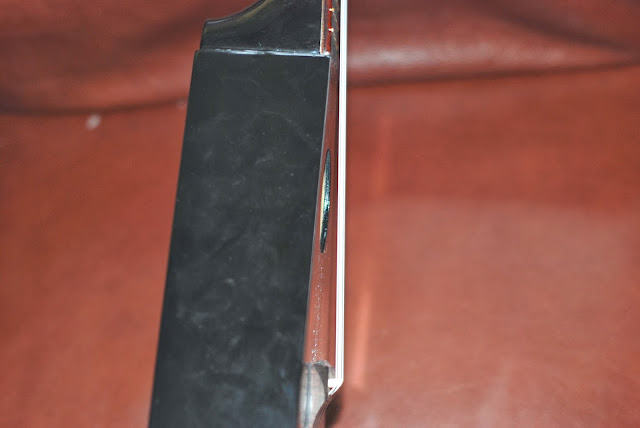
Moving on to the neck, the first observation is that the fingerboard fits the body flush. That is to say, unlike many ukes the fingerboard is not raised above the top of the body - it kind of runs directly into the body. Some older ukuleles used this build, usually because they set the frets directly into the neck. That is not the case here though as there is a fingerboard topped on to the neck, it is just deliberately set flush. For theatrics, some players like this because it allows you to fret strings beyond the neck directly onto the top of the body, although I doubt Mahalo introduced this design for that kind of player!
| note the string angle and thickness of the top |
I cannot tell how the neck is built as it is covered in thick paint, but it has a fairly standard, chunky C shaped profile which is pretty comfortable to hold. There are 14 nickel plated frets, and I know they are plated as it looks like some finish is coming off the lower ones and they are turning a brass colour. In fact one of the frets is showing signs of rust, so who knows how long this was sitting in a damp warehouse!
The fingerboard 'appears' to be rosewood, but I actually suspect it's something more generic as a glance at the (unbound) fingerboard edges shows that it has been stained with a rosewood coloured paint. We have pearloid looking fret markets at the third, fifth and seventh frets, and it is good to see they are repeated on the side of the neck. I don't understand why the fingerboard markers are differing sizes and think they look odd. I also prefer fret markers higher up as I have no issue finding the third and fifth frets, but I suppose this is a beginner uke.
The nut is cut from plastic, neatly applied yet the slots are far too high (more on that later)
The headstock mimics the headstock on the Gibson Flying V guitar in shape and looks kind of cool. It too is finished in black gloss paint. The Mahalo logo is applied by way of a transfer in a gold colour, but it is totally uninspiring and looks like it uses a very basic font and was applied as an afterthought.
The tuners are open geared, finished in gold plating and the mountings are shaped like dolphins (a dig to their rivals Makala perhaps?). The gold finish is tarnished, particularly on the string posts and they look much older than they should be. They are not quite set in line with the headstock, and the large black plastic buttons are FAR too big and look silly. They hold tuning ok though, but do grind and go from slack to firm on turning which is a sign of ultra cheap gears. A drop of chain oil 'may' help here.
Completing the package was a set of the most awful nylon strings I have ever encountered (now changed to Aquilas) and an extremely cool gig bag. Not quite sure how they include a bag like this for £30, but its white, leatherette finished with a really rather fabulous plush blue interior. A really nice addition.
So - some nice looks, but sadly let down with the finish and a fundamental error in the build. How does that translate into playing it?
Firstly, it is uncomfortable. To play without a strap, those V fins dig sharply into the arm, and I am not even sure where or how you would attach a strap button. Because of those angled sides the Mahalo is also uncomfortable to play sitting down as the neck of the instrument constantly wants to fall to the floor. If you are a beginner there are far more comfortable ukuleles to hold. It is also quite heavy on account of that overly thick laminate construction.
Setup wise, things are not great. The action at the saddle is not too high, but the nut needs cutting down a bit. Asking a beginner to lower a saddle is not a big job, but lowering nut slots is a more delicate affair. The string height here is too high, and the result of that is when fretting notes at the first and second frets, the tuning goes sharp on account of the string being pulled down too far. Looking at it side on though, whilst the saddle action is ok at the higher frets, that is on account of the build being wrong as the strings approach the neck on far to steep an angle, as the body seems tilted back a little. That is to do with that flush fingerboard fitting to the body. All bad for intonation and accuracy.
But that misplaced bridge really doesn't help things and intonation down the neck goes off fairly badly. The only fix for that is removing the bridge and re applying it, which is really not an option that a beginner is going to consider worth it on a £30 instrument.
The sound is pretty dead and one dimensional. A friend likened it to rubber bands on a margarine tub, and I know what they mean! It has a thin sound with very little sustain or character. And this is with Aquila strings, it was really dreadful with the stock strings. Volume is very low, and even with the power of Aquila strings, even the most vigourous strumming doesn't get a lot of noise out of it. All in all, pretty awful.
For me it is a novelty only, but actually that saddens me. The uke struggles enough at times to rise above the 'toy guitar' moniker, and Mahalo are doing nothing with this to help its cause. Further, I have played many entry level Mahalos that suffer from similar build issues and those ukes are (on account of their price) the ones that many beginners start out with. And that has always been my issue with Mahalo - when a new player starts on one of these I think they are capable of putting them off the instrument for life, or at best, re-enforcing the 'toy guitar' stereotype. For me, I would always suggest beginners spend a little more, but if £30 is indeed your budget I remain of the view that the Makala line is a far better bet.
| nice gig bag though! |
And.. if you don't want to heed my warnings - yes... they are available on Amazon.
PROS
The rock shape
Wonderful gig bag
CONS
Everything else.
SCORES
Looks - 7
Fit and Finish - 1
Sound - 2
Value For Money - 6
OVERALL - 4
To understand my review scoring and see this result in context - visit my review page at
Subscribe to:
Posts
(
Atom
)
Say thanks to Got A Ukulele
Please Help Keep This Site Going!
If you enjoy this blog, 'thank you donations' for the free content are welcomed. Aside from the Google ads, I don't get paid to write this blog and for reasons of impartiality a not sponsored by brands or stores.