GOT A UKULELE - Ukulele reviews and beginners tips
Showing posts with label pickup. Show all posts

20 Oct 2024

Kala Revelator Night Owl Tenor Ukulele - REVIEW

Well this ukulele has certainly started a stir and i'm therefore very pleased to be able to bring you this. The Kala Night Owl has arrived..

Kala Revelator Night Owl Tenor Ukulele

Read More »

21 Apr 2024

Luna Uke Henna Dragon Concert Ukulele - REVIEW

Got A Ukulele isn't just about the brands that I personally like, but rather tries to cover all bases for ukulele buyers to consider. This week we go back to a brand that is, sadly, yet to impress me with the Luna Uke Henna Dragon Concert. Or more specifically the imaginatively named UKE HEN DRA MAH C.. 

Luna Uke Henna Dragon Concert Ukulele

Read More »

21 Mar 2021

Kala KA-JTE 2TS Archtop Tenor Ukulele - REVIEW

It's ukulele review day, and Got A Ukulele returns to show it absolutely has it's finger on the pulse of new developments in uke-dom. Not really.... this was first released in the late 2000's... It's the Kala KA-JTE 2TS Archtop Tenor.

Kala KA-JTE-2TS Archtop Ukulele

Read More »

24 Feb 2021

Removable Ukulele Pickups - REVIEW

Here's a ukulele topic I have been to revisit for some time as I get asked about them so much. Are removable ukulele pickups any good?

external ukulele pickups

Read More »

6 Oct 2019

Freshman UKLMAPLEC Concert Ukulele - REVIEW

This week it is back to a ukulele brand that, until fairly recently, were new to me. But it's a brand I am increasingly seeing being carried by specialist ukulele stores (a good sign). This time it's the Freshman UKLMAPLEC Concert Ukulele.

Freshman UKLMAPLEC Concert Ukulele

Read More »

17 May 2017

iRig Acoustic Stage - REVIEW

I've been getting a number of emails asking about ukulele amplification lately. So hot on the heels of my last look at a ukulele pickup, I'm pleased to bring you another option in the form of the iRig Acoustic Stage.

irig acoustic stage


Read More »

23 Apr 2017

Kremona UK-1 Ukulele Pickup - REVIEW

Here's something a bit different for you. A passive ukulele pickup that requires no drilling, no gluing, no taping to the body. It's the UK-1 Pickup from Kremona.

Kremona UK-1 Ukulele pickup

Read More »

10 Jul 2016

Cordoba 20TM-CE Tenor Ukulele - REVIEW

Another first for a brand on the Got A Ukulele reviews pages, this time from globally known Cordoba musical instruments and their 20TM-CE Tenor ukulele.

Cordoba 20TM-CE Tenor Ukulele


Read More »

22 Apr 2015

Going Electro Ukulele Should Cost You MORE Not The Same

There seems to be an awful lot of discussion at the moment in social media circles about people wanting to amplify their ukuleles. I see this generally as a positive thing as I suspect it means they are wanting to perform live. I say 'generally' because amplifying just for the sake of volume is probably not a great reason, but there you go.


ukulele pickup system

I have talked before about amplification options so I won't repeat all of that here. In short though you have a couple of main choices - either to use a microphone in front of the instrument (and that will give you hands down the most authentic tone reproduction) or using a pickup inside the instrument. The pickup option has its downsides, particularly if they are cheap, but with a good quality one and the right amplifier you can get a very pleasing tone from them. In fact the lions share of professionals you will see on festival stages perform with pickups this way. There are people who perform with microphones too of course and they sound great, but for many the versatility of a pickup system is the ability to move around and not be tied to the microphone coupled with a big reduction in feedback on stage. I suppose your type of act will come into play here as to what suits you better.


Read More »

22 Mar 2015

LR Baggs Venue DI Pre-amp - REVIEW

I've spoken before on Got A Ukulele of the benefit of a pre-amp box if you are plugging in to an amplifier. Last time we looked at this model from Fishman which is rather good. Time to look at what may be considered a luxury option, particularly with a price tag of around £300. The LR Baggs Venue DI. But does that cost make sense?


LR Baggs Venue DI


I've been a fan of LR Baggs gear for some time, particularly their Gig Pro series of belt clip pre amp boxes. They just sound incredibly clear and natural with acoustic instruments and far more so than any many other pre amp boxes which can still leave the ukulele or guitar with an electric guitar type sound. Above the GigPro is the Baggs Para DI which adds some more detailed tone shaping controls to the mix. Now we have the Venue DI which takes those technologies and adds more.


Read More »

7 Aug 2014

Kamoa E3E Bass Ukulele REVIEW

You know, it surprises me that out of all the instruments I have reviewed on this site, I haven't yet looked at a ukulele bass. I suppose there are not that many about if the truth be told, but they are becoming increasingly popular. I was therefore delighted to have this Kamoa E3E Bass ukulele sent to me on loan by the good folks at Southern Ukulele Store.


Kamoa E3E Ukulele Bass


Confession first though. I am not a fan of ukulele basses. When I started on uke, there really was no such thing and then Kala came through with their U Bass models, the ones with the rubbery strings. I don't want to be controversial but I just don't like them. I just cannot get on with those thick, grippy strings that kind of twist on the fingertip and take an age to settle into tune. Don't get me wrong, in the right hands (and I am no bass player) they have a terrific woody sound, very like a double bass, but those strings and their low tension just niggle with me. But there is another reason too..... Why a 'ukulele' bass? A ukulele is the size it is because of its history and heritage. Its a ukulele, that is how they look! So why the drive to make a bass guitar smaller? Why does it need to match the ukulele on scale?  At a gig of ours some time ago somebody said to me afterwards (having spied our full scale bass guitar) 'oh I suppose you 'get away with' playing a bass guitar because it has four strings?'.... I was lost for words.... Getting away with what??  Because we play ukes doesnt mean everything has to be miniaturised... We use a regular bass guitar because we like the sound. End of! As such I have always been confused as to why there is a U Bass market. But... there is, and it is growing, I just  never felt compelled to join the clamour for one on account of THOSE STRINGS!

The Kamoa arrived though and I was extremely pleased. You see the E3E is a bass in every way, down to the fact it uses steel flat wound bass strings and not the rubbery ones.  I was always led to believe that Kala went with the plastic strings to keep the tension down and therefore not destroy the uke, but Kamoa seem to have done it, and with more tension than a U Bass too! Let us take a closer look.

The Kamoa E3E is essentially a far eastern made baritone ukulele body with a wider bass neck stuck on to it. The body is in traditional figure of eight shape and is made from solid woods (spruce on the top and maple on the back and sides).  The top is made from two pieces and is stained in red satin finish which just about allows the wood grain to show through. The sides are finished in a similar way and there are no flaws in the finish whatsoever making it feel very tactile if a little one dimensional. The top and back are joined to the sides with inner notched kerfing, and outer cream binding with some black white black trim. The back has a slight arch to it too.  It all looks very clean though I think and goes together well.

Kamoa E3E Ukulele Bass body


The saddle (which appears to be NuBone or similar) sits in a rosewood bridge mount with a nice shape to it, and the strings are held by traditional acoustic guitar pins. I find pins fiddly on ukuleles but with this instrument using ball end bass guitar strings, tying knots in the 'ukulele way' would look a total mess. Aside from a small simple sound hole ring (a transfer) there is little other bling on the E3E at all.

Kamoa E3E Ukulele Bass bridge

Kamoa E3E Ukulele Bass sound hole


The neck is wide to accommodate the extra string girth but is fairly shallow in profile. It is made from two pieces of maple with a joint at the heel and again is stained to match the body. The fingerboard is rosewood and appears to be edge bound (though that may just be darker stain) to hide the fret edges. It is a nice even piece of wood and holds 17 nickel silver frets with 12 to the body. One really nice thing to see is that the fretboard is 'radiused' meaning it has a very slight curve across the face to allow for easier playing, particularly with a wide fingerboard such as this.  Edges of the rather chunky frets (this is a bass!) are very nicely finished and we have large pearloid fret markers at the 3rd, 5th, 7th, 9th and a double marker at the 12th. For the player there is a single small side marker at the 7th (well done Kamoa!).

Kamoa E3E Ukulele Bass fingerboard


Past the chunky dark wood nut (rosewood again I think) we have the standard Kamoa headstock shape. I do like it, and whilst it is still yet another crown shape it tapers from the base to the top and I think looks very classy. It is faced with what I think is rosewood with a  small diamond Kamoa logo inlay in maple. All I would say is this headstock shows how nice a finish Kamoa can come up with but it kind of jars against the expanse of red on the rest of the instrument.

Kamoa E3E Ukulele Bass headstock

The tuners are unbranded metal sealed gears finished in black. Basically they are small ish bass guitar tuners and work just fine.

Kamoa E3E Ukulele Bass tuners


Finishing the package is an onboard active pickup system which is branded Kamoa but looks generic to me, perhaps a Belcat. It comes with volume, bass and treble faders and a low battery indicator and runs from a 9v battery. I am not much of a fan of these systems, but there you go. It is functional enough at this price.

Kamoa E3E Ukulele Bass pickup controls


So in short, it is a bass acoustic guitar in baritone uke size and retails in the UK for about £300. It is also designed to be tuned EADG like a regular bass but an octave up (same tuning as a U Bass, but the U Bass is the same as a regular bass guitar or double bass).

Testing it for play is not the easiest thing I can do as I am not a bass guitar player, but the thing that struck me first is that it is considerably louder unplugged than a Kala U Bass, and dare I say it, feels more solid and 'bassy' too. An acoustic bass is never going to be super loud, even at full scale guitar sized, but it sounds great for unplugged practice on account of those steel strings. Oh, and a pick makes it even louder!

The neck feels great in the hand and very much like a full scale bass to me. The setup arrived spot on with very little buzz (in my clumsy bass experience I always tend to create a bit of resonance buzz when I play one), but it is all nice and clear. Accurate across the neck too.

Kamoa E3E Ukulele Bass jack socket


As I said above, the tuners work just fine. They are perhaps a little sloppy when starting to wind, but when in tune they hold just fine.

But it was the pickup I really wanted to try out and it works. I did find that strings 1 and 4 were a touch louder on this, with string 4 giving the uke an overly bass sound even without the bass fader anywhere high. This  would just be a simple tweak to ensure the bottom of the saddle is seated properly and through a fuller bass rig I am not sure I would notice all that much.  It doesn't sound anywhere as woody and thumpy as the Kala U Bass, and you may not like that, but these are steel strings so it is natural I guess. I do find it a lot brighter sounding than I would expect from a bass though and think that cheaper Piezo pickup has something to do with that as it sounds very 'electric' if that makes sense. A good pre amp or amp generally may well work wonders here.

Overall though it is very well put together and looks the part. I like the red colour I guess, but underneath it is actually a fairly plain ukulele and some more glamorous wood choices may have improved it I guess, as it looks a touch uninspired to me.  As I say though, the build is great.

Kamoa E3E Ukulele Bass back


To me though it is really just a small acoustic bass guitar and the jury is still out for me as to why there is a need to call it a ukulele when it isn't...  That isn't a criticism of the instrument itself, more of the uke bass fad - the instrument is a great little thing I think. If you are already a regular bass guitar player or a Kala player who doesn't get on with U Bass strings, these have got to be worth having a look at.

But it is the price that should really turn your head - £300 is on a par with the Kala Rumbler, and cheaper than other U Basses including the Ortega. Great great value in my view and a must see for anyone moving to the bass side!

Check out the video review below and then the scores on the doors!

PRO's

Price
Steel strings
Build quality

CON's

Cheap pickup system
Striking red finish but underwhelming woods underneath


VIDEO REVIEW


SCORES

Looks - 8
Fit and Finish - 9
Sound - 8
Value For Money  - 9

OVERALL - 8.5 out of 10

To understand my review scoring and see this result in context - visit my review page at
Read More »

27 Jul 2014

Fishman AG 094 Ukulele Pickup - Review and installation

So yesterday I got around to doing something that I have been meaning to do for some time. Fitting a passive ukulele pickup to my Kanile'a Tenor ukulele. 

Being an expensive Hawaiian uke, this was a somewhat nervous process, but actually, if you go steady and carefully its not all that bad. Thought I would provide a kind of semi review and comment on the installation process to help others out. The model pickup in question was a Fishman AG series 094 ukulele pickup.


Fishman AG 094 ukulele pickup


A quick word in advance on pickups. If you want to go down the electro acoustic route I will always recommend that you first consider the installation of a good quality passive pickup ahead of the on board pickups that feature on many entry level ukes. In my experience, these on board 'active' pickups are rarely of the sort of quality you can get with a passive strip, and often REALLY poor quality. If you think about it - there are electro acoustic equipped ukes on the market from about £100 or so upwards. The cost of this Fishman AG 094 alone is about £75, so what does that tell you about the quality of either the uke or the pickup on the ready to go models? The other advantage with fitting a passive pickup is that you can choose to fit one to any acoustic uke and not limit yourself to certain models. Stores will often offer to fit these for you for a bit of extra money, but as I hope to demonstrate below, its not actually that complicated to fit one yourself.  This post is about the fitting of an under saddle piezo pickup but other types are available, most notably transducer spot pickups that stick on the underside of the top under the bridge. I prefer under saddle models myself though as they pickup less body noise.

So, whats in the Fishman box? Not a lot really - a thin ceramic pickup strip with a wire connected for connecting to the jack socket, and a jack socket itself. And that is it. The Fishman pickup requires that you solder the wires to the jack socket as part of the install process, but there are models out there, such as those from Shadow that come either ready wired, or with plugs to clip them in to the socket. I went for the Fishman as it was very thin, and that meant less work to do on the saddle, but I also found the soldering meant for a slightly easier install. You see, when the whole thing is already hard wired, you need to find a way of getting the pickup strip up through the bridge from the inside out. It can be done, but with the Fishman, you install the pickup strip from the outside in, then solder the wires to the jack socket before fitting that. Much easier.

So what is the process? Well, aside from the soldering, its really just a case of drilling two holes, and doing a bit of sanding.

First up we need to drill a small hole in the bridge to feed the pickup wire through to the inside of the body.  I removed the strings and the saddle (after marking up the bridge for the string positions to allow me to line up the strip so it sits evenly under all the strings) then marked the wire location for the pickup.  It's then a simple case of drilling a hole within the saddle slot right through the top of the uke. The diameter will vary depending on the pickup system, but in this case it was about 2.5mm. Go steady, and ideally drill a very thin pilot hole first to guide the drill, but its really not too complicated. With the Fishman, the pickup wire extends directly downwards from the end of the strip, so a hole drilled directly downwards was needed to ensure the pickup sits flat with no pressure on the wiring. Some pickup strips use a braided pickup and the wire will then need to go into the uke on a slight angle to avoid it stressing. In those cases, just drill on a slight angle towards the edge of the uke

Drilling bridge hole for installing ukulele pickup
Hole drilled for pickup strip wire


The second hole is the one that gets the pulse rate racing, and that is one right through the butt of the uke for the jack socket. In this case it was about 12mm, which is a chunky drill bit, but again I would recommend drilling a thinner pilot hole first to guide the drill. I didn't use a clamp or a vice to hold the uke (rather I had a wife to hold it for me!) but would recommend one if you have one. Again - go slow and steady and soon you will be through. Give the inside of the hole a bit of a tidy up with a file then hoover out the dust and wood shavings out of the uke before you continue. Another word of warning - if you are drilling this way, ensure that the instrument has an end block fitted to take hold the jack socket. This one does, as do most ukes,  but if you cannot see one in your uke I would recommend an alternative system that involves a wire coming out of the sound hole to an external jack. Without an end block you are applying undue stress to the thin side pieces of the uke. I have seen an example of such a fitting where the instrument lead was pulled, and it ripped the jack socket out of the side of the uke leaving quite a hole!

Drilling ukulele for jack socket
Hole drilled for jack socket


And that is it for drilling, so on to the installation.  Feed the pickup wire through the top of the uke and into the body. As I say above, if your pickup system is pre wired, then you need to feed it the other way as everything is connected and I would recommend doing this with either some cotton or thin wire through the body and connected to the end of the strip to feed it back through, but I warn you, that is fiddly!. So with the pickup strip seated in the slot, you can now reach into the uke to grab the loose wire and feed it out of the sound hole.

Fishman AG 094 ukulele pickup seated in saddle slot
Pickup strip seated in saddle slot


Solder the wires to the end pin jack and we are almost there. In the case of the Fishman AG, it comes with a clever multi use jack pin that allows the soldering of secondary pickups, or mic pickups to share the jack, but in the case of this passive strip, its a case of soldering the central 'hot' wire to the tip pin of the jack, and the ground wire to the the sleeve. All instructions with diagrams are on the Fishman website. Another tip here - you will find that you have more wire than you really need, so before moving on, coil the wire a little and either secure the loop with tape or a cable tie to ensure you don't have loose wire flapping about inside the uke.  You can also attach the loose wire to the inside back of the uke with some tape for extra security. With that connected its time to attach the jack socket.

To do this, I fed an instrument cable with a jack that was thin enough to go through the hole in the base of the uke and plugged it into the jack to feed it back out. This takes a bit of fiddling and trial and error as you need to ensure it protrudes through the uke enough to take the locking nut. On the shaft of the jack socket are a bolt, washer and star washer designed to sit inside the uke, and then it is attached with another washer and bolt on the outside to hold it in place. This took a few goes of adjusting the inner bolt to the correct depth to ensure I had enough to work with outside but it didn't take too long. With the socket passed through the uke and enough protrusion to work with it is then simply a case of attaching the outer washer and bolt and tightening it. The jack socket has a hole drilled through the side to allow you to insert a pin or allen key or similar to keep it from turning whilst you turn the bolt. Tighten it up firmly, but not enough to damage the uke finish.  With the Fishman, the jack socket comes with an outer bolt that screws over the jack to provide you with a strap button. Handy!

Jack socket fitted to ukulele
Jack socket bolted in place


And we are almost there. The last adjustment is to now go back to the saddle. The installation of the pickup will naturally raise the saddle higher so your action will need to be adjusted downwards. I actually picked the Fishman as it was thinner than many other pickups meaning less to do here. You have a couple of options. First you could rout the base of the saddle slot down a little so the pickup sets in a recessed chamber but this would be a very delicate process with tools I don't possess. If you go this route you will need to be absolutely sure that the base of that saddle slot remains totally flat as efficient use of of a strip pickup requires even contact with the saddle and body of the uke.  It is also essential you don't go too deep as well as you risk damaging the underlying top of the instrument. The alternative (and the option I took) was to sand the base of the saddle down a little to return the uke to the original action. Again, it is totally essential that you sand the base completely flat, but with this pickup strip it took only about 1mm to take the saddle down.

And that is it really. Re-strung the uke and gave it a test and the volume across the strings is nice and even as it should be. A sign of an uneven saddle or slot base would be one or more strings ringing louder than the others, but no such problems with mine.

As for the quality of the pickup tone itself, well, any passive pickup will perform best through an external pre amp box as they can otherwise sound a little thin. On this one, even without a pre amp it sounded clear enough, but really really nice through my Fishman Pre amp that I usually use on stage. It sounds remarkably natural in tone, like a uke in fact. That may sound like an odd statement, but that is my other complaint about cheap on board systems that run off batteries as I find they make the uke sound too 'electric'. No concerns on this score with the Fishman AG.

There are better and worse pickup strips out there, and you can spend considerably more if you want to, but I am delighted with the ease of installation with the Fishman and with the sound it creates. I accept that for many the process of drilling instruments may be something that scares them, but it's really not all that complex if you are careful and give it time.

As for the Fishman pickup - recommended!

http://www.fishman.com/product/ag-series-1


Read More »

8 Aug 2013

Godin MultiUke Tenor electro ukulele - REVIEW

Time for a ukulele that is a little out of the ordinary, and perhaps a uke that will divide opinion. Say hello to the Godin MultiUke.


godin multiuke tenor ukulele

I have been a fan of Godin guitars for many years - a Canadian company from Quebec with a reputation for making excellent instruments, and products with something of a difference. Some years ago, Godin launched their Multiac electro acoustic guitars - strikingly different looking instruments with a rather unique pickup system. They are very highly regarded for studio and stage work, yet do, it must be said, divide opinion. In recent years, Godin have used that technology on a range of other stringed instruments, so it was a matter of time before they tackled the ukulele.

The MultiUke takes that Multiac technology (and looks) and applies it to a quite unique tenor instrument. In short summary it is primarily an electric ukulele, but built around a semi hollow chambered body to give resonance without feedback (there is no sound hole!). The devil is in the detail with the MultiUke and Godin say they designed this, and the pickups from the ground up in order to give superior sound and playability. With an RRP of $850, this is no cheap ukulele, but more on where that money has gone below.

So we have a regular (ish) tenor scale ukulele (17" scale). The main body is made of chambered mahogany, actually made of two pieces joined down the middle, and topped with either a solid cedar top (as in this case) or an alternative sunburst spruce top. As pretty as the sunburst looks I opted for the understated looks of solid cedar. The chambering inside the body of the instrument is otherwise hidden but serves a couple of purposes. First it is mainly chambered around the lower bout of the uke and under the bridge to give resonance and to allow that top to move. This is essential for sustain and tone. The chambers also house the various wiring, pickups and batteries that drive the thing.

So first, let's take a look at that top. It really is a rather pretty piece of wood. There is no curl in this (being cedar I suppose) so we have nice straight bold grain lines that run perfectly from tail to neck. It is made of two pieces of solid cedar joined down the middle. And there is a LOT of cedar to look at. Whilst this is a tenor scale, the uke is wider than most tenors I have played, particularly around the butt. As I say above, there is no sound hole on the MultiUke - a plus point for live performance, as no feedback from the sound hole, but meaning more cedar on show. The only holes on the top are the entry point for the neck truss rod bolt and the channels for the sound control sliders next to a Godin name label. More on those further on. The finish of the top is a high gloss, and whilst I am not normally one for gloss, this is beautiful and will protect what is otherwise quite as soft wood. It's simple looking, yet on a far from traditional design. In that sense I suppose it doesn't need any bling!
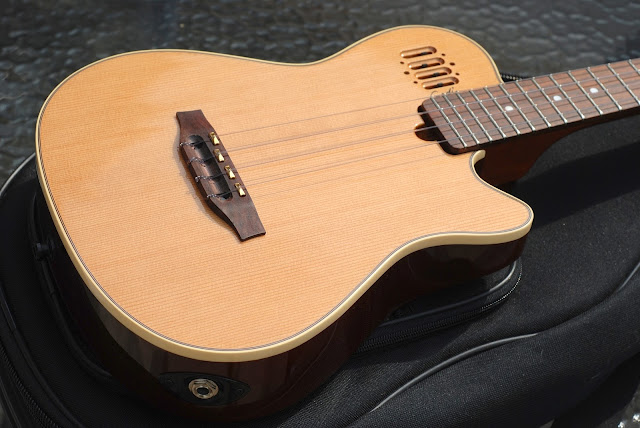
godin multiuke cedar top
Cedar top

The top is joined to the chambered body with cream edge binding with a black trim. It is applied very nicely and quite deep and I think provides a nice contrast with the much darker coloured back. Overall I love the shape of the top, which is vaguely Telecaster ish, using a slightly squarer top horn to house the controls, and a cutaway for high fret access on the bottom horn.

I won't talk about the sides separately from the back as they are part of the same construction. The back is a chunky affair, finished in a beautiful deep red gloss that really shows of the mahogany grain beneath. The back is also shaped and tapered rather like a Stratocaster with a slight curve inwards on the top edge of the back, and also on the horn making for a more comfortable playing experience when you have this thing strapped to your body. I think it looks wonderful. Elsewhere on the back we have the access port for servicing the pickup controls, and a compartment for a 9v battery. Strap buttons are provided made of blackened metal on the butt and on the top horn adjacent to the end of the neck. The jack socket is not square on the base but offset like you will find on many electric guitars and is mounted on a black metal surround.

godin multiuke back
That gorgeous contoured back


The whole body feels very solid and makes it come across as a serious instrument. It's rather like the first time you pick up a Gibson Les Paul... That construction also shows in the weight - this is a heavy ukulele and certainly heavier than any traditional electro acoustic you will find. That is not to say it is overly heavy but serves as another element that may divide opinion. If you play this uke standing up you WILL want a strap.

godin multiuke jack socket
bottom strap button and jack socket

On to the neck, and the first thing you notice is that it is bolted with three screws to the body, making it one of the first ukes I have seen to employ that design. I suspect the reason is down to the construction of the chambered body meaning it would have been too much of a job to create a set neck in a pocket. The debate always rages in the electric guitar world as to whether set necks or bolt on necks are better, but I have never been convinced either way. At the end of the day, it works for the Stratocaster, the worlds best selling electric guitar, but I appreciate this too may put off ukulele purists. Another point on that though. The bolt on design means that the uke action can also be tweaked over time by re setting the neck with a shim to raise or lower it away from the strings. I suspect you will never need it but the option is there if you are that way inclined. In addition, if you snapped the neck, fitting a replacement would be a five minute job!

The neck is made of mahogany and I was pleased to see it is finished in satin and not gloss like the rest of the uke. A gloss finish neck can, I find, feel quite sticky on the hands. This is silky smooth and very nicely finished.  The neck is made of three pieces with a joint at the heel, and one at the very end of the headstock. This is a slight disappointment on account of the price, but will in no way affect the sound (nor is it noticeable). I really do like the whole design and shaping of the neck joint, but I am geeky like that.

godin multiuke neck joint
Neck joint and bolts

The neck is topped with rosewood and comes with 19 fairly chunky nickel silver frets. The rosewood grain is dark and straight with no pale patches or stripes. Fret markers are in mother of pearl at the 5th, 7th, 10th, 12th and 15th and these are, thankfully, repeated on the side. The edge of the fretboard is unbound which I found surprising, meaning the edges are visible. I think a cream edge binding would have really set the ukulele off and matched the body. That said, the whole neck and the frets are finished beautifully with not a rough edge in sight. The fret board is also radiused which is usually something reserved for the highest end ukes. That means the frets are not set completely flat, but the fingerboard has a very slight curve to it (a 24" radius in fact). This adds to playability as it provides the fingers with a more natural landing position. And yet another plus, the edges of the fretboard are rolled and curved - another high end uke trait, meaning no hard edges and a silky smooth feel.

And.... we have a truss rod! This is a threaded bolt of metal that runs through the length of the neck and is adjustable to create a slight bow in the neck. This is common on guitars, and an essential tool for adjusting action (to some degree) but more importantly playability. It allows a small amount of concave relief to be put into the fingerboard making playing easier, and reducing buzzes. Rarely seen on a uke (with the exception of Pono) it's a nice addition. Access to the truss rod is via a small opening on the top, and Godin even supply you with an allen key to adjust the hex bolt.
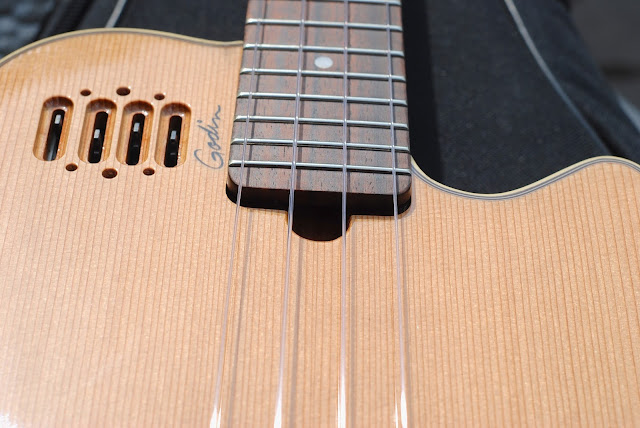
godin multiuke truss rod opening
Truss rod opening

Up to the headstock, we first pass the nut which is made of Tusq Nubone. I adore the shape of the headstock and the finish of the facing plate which is in a kind or raised glossy black wood finish. It really does give the instrument a high end feel and look. The Godin logo is emblazoned across the top, with the words MultiUke and MADE IN CANADA in a different orientation which jarred on me a little I must say. I don't think either are really necessary, so why not stick with just 'Godin'?

godin multiuke headstock
Headstock

Flipping the headstock over we have unbranded but very pretty open geared tuners, with classy shaped silver buttons. The instrument serial number is also embossed in the back of the headstock wood.

godin multiuke tuners

Yet, so far we haven't actually looked at what makes this ukulele rather different. The pickup system. Godin have utilised a custom voiced RMC brand system on the MultiUke. They say it was developed specifically for this instrument, but underneath its basically the technology they use on their Multiac guitars. This is a seriously high quality pickup and goes some way to explaining why this instrument has the price tag it has. You will spend the best part of $200 to get an RMC acoustic pickup system on it's own, so this is no cheap $50 piezo strip.

A quick word on that. Readers of this site will know that I normally prefer passive systems to those with on board electronics. Generally it means the uke will sound more natural. This is not a passive system, it's a powered one and therefore may seem to go against what I prefer. All I will say is, read on, and bear in mind that this is a professional pickup system, not a cheap Belcat that get's fitted to a $150 ukulele.

The RMC pickup differs from most other systems you will have seen in that it provides an individual pickup to each string. That's right, four pickups! There is no normal saddle on this instrument as you will see, rather each string sits on it's own pickup saddle that have been placed into the rosewood bridge. They look great and are finished in gold, like four little shiny pyramids. On the top of each is a groove to keep the string in place.

Controls for the system are provided on the top left of the top of the uke, by way of four sliders. These control volume, treble, middle and bass providing a lot of sound shaping options. Again, more on that later.  The whole thing is powered by a 9v battery in the back of the uke and outputted via a standard 1/4 inch jack socket.

godin multiuke pickup controls
Pickup controls

A couple of things to note about those pickup saddles. They are set in one place and one place only, admittedly in a compensated layout. I've seen a few people complain about that as they cannot adjust the scale length when moving to a low G string. I am not sure I am convinced by that as an issue, and equally have read words from some very experienced uke techs saying that it won't be a problem. You may need to experiment with string guages, but on a scale length like this, you should not have an issue (unless you are so OCD about your 15th fret note being within 0.01% of accurate...). Put another way, my Kanile'a Tenor uke doesn't have a compensated saddle, and I switched to low G on that with no issue on intonation whatsoever. The other issue is saddle height, but I am told that these individual saddle pieces can be taken down.


godin multiuke pickups
Pickup saddles - shiny pyramids!

Completing the package are a set of D'Addario Titanium strings, and a rather lovely and chunky zippered gig bag that comes with the Godin logo, accessory pocket and strap (quite honestly the best quality padded gig bag I have yet come across).

Enough description, on to playing the thing! First up, how does it feel and what is the playability like?

Well as I said, it's a chunky, quite heavy instrument, but it is a delight to hold and feels really solid in the hands. That contoured body is extremely comfortable when used with a strap, and when seated, the size of the body when rested on the knee means it doesn't get lost on your lap as can happen with standard ukes. In fact, whilst the uke world usually despise the instrument being referred to as a 'small guitar' that is exactly what it feels like. That size though has it's disadvantages, as I have not yet found a hard case that it will fit into. And as nice as the padded bag is, for travelling I think that for the money Godin should have stretched to a hard case for it. Without wanting to get into the strap debate yet again on Got A Ukulele.. when I say you WILL want a strap, that is about weight on extended playing sessions. The uke is actually very nicely balanced though and I found it quite easy to play without one, perhaps helped by the large body width and narrow profile making it easy to grip with the forearm.

The neck is somewhere else I think this uke really shines. Firstly, we have quite a wide nut which I much prefer, but also a deep and chunky profile which I find really comfortable The rolled edges and radius on the fingerboard are also immediately noticeable making it an absolute joy to hold and play. Guitarists use the term 'fast neck' on instruments that are easy to play, and this MultiUke fits that bill. Chord changes are a breeze, as are fingerpicking runs. It's a neck that just longs to be held and is the first uke I have come across that feels as good as my Kanile'a Tenor in that regard (and that is a delight to play and hold!)

The setup is just about perfect for me, with zero buzz, a well cut neck and action all over the uke to my liking. No complaints there. As I say, there is a truss rod here, so if you did have buzz or high action that can easily be fixed and may only need a tweak and a possible change to the nut slots. Easy.

On to the sound, and I will deal with the acoustic side first. I was actually surprised to read that so many people being interested in the acoustic sound, as this is predominantly an electric instrument designed for plugging in on stage or in the studio. As such, the acoustic sound was not something that really crossed my mind when ordering it. That said, it's really surprising as there is a half decent sound to it. It's not the loudest uke I own, but as loud as some, and certainly louder than things like the Epiphone Les Paul (another chambered uke). The acoustic sound is a little thin though, as the uke is lacking a soundhole to project the more complex tones a traditional ukulele will give you. Perfectly passable though, and great for more refined practice or late night, and MUCH louder than a solid body electric uke. The balance between the strings is clear and it has some really nice chimes to it. But that's not really what the MultiUke is about. Let's plug it in!

WOW...

Yes, I really have been blown away. The sound plugged in is, frankly, wonderful. Every string is bang out clear in the mix, and the harmonics both when strumming and even more so on clawhammer picking are quite sublime. In fact the nicest I have heard on an electro uke before. I have read some find the sound a little clinical, but I think it is far from that. It has a shimmery warmth to it. And as for the sustain - quite incredible really. The uke sings and sings when picked. At this early stage in ownership I can't say enough nice things about the sound. I will get around to a recording at some point, but at the moment the studio recording gear is packed away and all over the place. I will do it though! All in all, it certainly has a voice of it's own and has not disappointed me one bit but of course, your mileage may vary.

But this is more than a plug in and play uke.  As well as the high end pickups themselves, you have a high end EQ system. On many cheaper ukes I tend to bypass these systems and EQ the uke either on a mixer or amp / pre amp to get the sound I prefer. That's because on cheap systems they tend to really only offer tinny or muddy with one balance sound in between. Not so here. These sliders really do make all sorts of subtle differences, and even a slight tweak of just one of them gives a noticeable change to the sound. This means you can spend hours shaping your tone to suit exactly what you are playing. Even cranking the bass fully up doesn't lead to a muddy sound, it just adds more clean bass. A tweak up of the middle and a drop on the treble and bass gives a more electric guitar type sound, and with the EQ flat it sounds like a very, very nice acoustic uke. That's not to say a pre amp wont be helpful, but it is common for Godin Multiac guitar users to happily plug straight into the desk.

And the lack of a sound hole ( and therefore no feedback) means you can really crank it if you want to. I played it this morning in a small study plugged in to a Marshall 50W acoustic amp and could pretty much turn it fully up with virtually no distortion or feedback. At any volume the notes are all there in the mix. As such this will make an excellent stage ukulele (the very reason I bought it).

The sound is balanced, helped by those individual saddles, so there is no chance of you endlessly chasing dead spots in under saddle piezo strips sending one string quieter than the others. It's kind of like having four individual microphones on four different strings!

So I am rather pleased with this one. And as I said from the off, I know this may divide opinion. It's certainly not traditional looking, but then I prefer builders to break from the norm. Why does every uke need to look the same? But do I have any gripes? Well, it is expensive, there is no escaping that. I understand why though, but still think the price is a little over cooked. And for that money, I think there are a couple of minor corner cuttings, such as the lack of binding on the fingerboard, the gig bag not being a hard case, but they are indeed minor.  I suppose there is some concern at the serviceability of that pickup system - changing a piezo strip and saddle is easy - this one, less so. But then Godin do have a good name and I wouldn't expect a problem.

At the end of the day, for many it will be a love it or hate it instrument, but either way, if you come across one I would urge you to give it a play. It may change your mind!
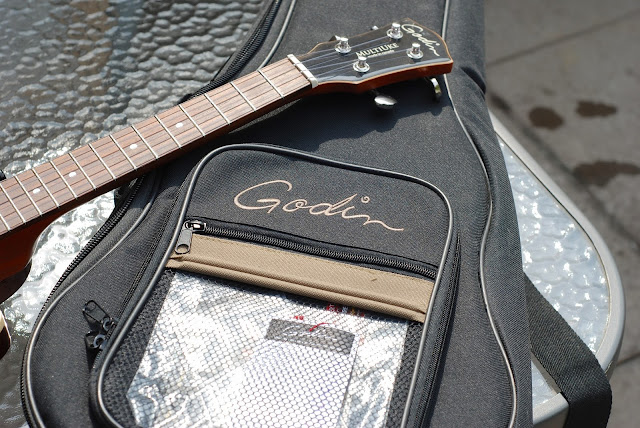
godin multiuke gig bag
The high quality gig bag


SCORES

Looks  - 9.5
Fit and finish - 9
Sound - 9.5
Value for money - 8

OVERALL - 9 out of 10


To understand my review scoring and see this result in context - visit my review page at

Read More »

13 Feb 2013

Barnes and Mullins BMUK3CE Calthorpe Ukulele REVIEW

Time for a new ukulele brand for me, but one that has quite a bit of buzz about it - Barnes and Mullins, and their Calthorpe model concert with pickup - the BMUK3CE.


Barnes and Mullins Calthorpe electro ukulele


Barnes and Mullins is a trade name of a very old UK instrument manufacturer that has been brought back to life on a range of new instruments including ukuleles. That heritage does not however mean that the ukes are hand built in a dusty English factory, as their range are made in the far east like so many ukuleles today.  The Calthorpe line replaces the popular Bowley range of ukes which I think are no longer made by the company, but received many decent reviews. How does this one stand up?

This Calthorpe was bought from Southern Ukulele Store for a little over £200, and is the concert model with an active pickup fitted. Out of it's case for the first time and it really is quite a looker, particularly on account of the woods and the colouring. This is a deep deep bright red and really rather pretty from all angles. The whole body is finished in gloss. The body shape is traditional uke with a double bout though as you read on you will note one or two elements which set the uke apart from others.

Barnes and Mullins Calthorpe top and bridge


The top of the instrument is made from solid spruce and has been stained a deep red colour which I think looks just great. Bling wise the front of the ukulele is tasteful, with a simple soundhole rosette and standard looking black / white / black plastic edge binding. All very nice. The bridge mounting is made of rosewood with a nice thin pair of white inlays which make it look a little different. The bridge is a tie bar design and the saddle is plastic, though compensated.

But it is on to the back and sides where things start to get really pretty. The sides and back of the Calthorpe are laminate woods, not solid, but are faced with a flamed maple veneer which is really rather stunning to look at. It has a really shimmery stripe to it, and again is finished in a red stain which sets it off. I really like the back of this ukulele! The back is also slightly arched which is good to see and will help volume protection.

Barnes and Mullins Calthorpe ukulele flamed maple back

Inside the uke is fairly standard looking, with notched kerfling. The bracing looks a little rough with some wood curls hanging off them, and there are also spots and smears of the outer finish in the inside - a messy interior!

On to the neck and things remain really pretty. The neck too is also made of flamed maple and the stripes in the wood pattern continue here - really rather nice. In my reviews I will often mention whether the neck is made from a single piece of wood, or in several parts. It doesn't really affect the way a uke sounds or plays, but it is an indicator of the quality of the instrument (generally speaking), as a single piece neck takes more work and effort to produce. Well this appears to be a two piece neck, but not like one you often see. I think the neck is put together in two halves along its whole length and where they join is a very attractive black inlay which I think looks great. The neck profile is not too chunky but very comfortable to hold.

Barnes and Mullins Calthorpe ukulele neck


On to the fingerboard. This is topped with ebony which is nice to see at a ukulele of this price. It is dark and very nicely finished. It is also bound on the edges hiding the fret ends which is a nice touch. There are 16 nickel frets with 12 to the body and they are all seated and finished nicely with no sharp edges.  Fret markers are inlays of mother of pearl in star shapes at the fifth, seventh, tenth and twelfth frets. There is also a single solitary side fret marker at the seventh. Honestly..... I often rally about why some makers fail to include side markers (being the markers that the player finds useful!), so come on Barnes and Mullins - if you chose to put one on the uke, why not put one on the other frets - I mean, it is only a dot!

Up to the headstock, and past the plastic nut and we see a quite unusual shaped headstock which I think brings a bit of relief from the scores of instruments that simply copy the Martin three pointed crown shape. It's rounded and faced in the same flamed maple. The Barnes and Mullins logo is screen printed in black under the gloss and looks classy. Tuning is provided by sealed, unbranded geared tuners with pearloid buttons. They work just fine, but I think they stick out a little too much and would have preferred friction tuners, particularly on a headstock of this shape (and with it being a concert).

Barnes and Mullins Calthorpe ukulele headstock


The pickup system is unbranded, but is under saddle and is powered by a 9v battery housed in a compartment on the side. Treble bass and volume control are provided by sliders (I would prefer dials and find these fiddly) but they do the job.  I am told that the pickup is actually a UK2000 system which are considered to be reasonable. Output for the instrument lead is provided by a jack socket on the base but off to the side, and as such this doesn't come with a strap button (the one in the picture I fitted myself). If you are building an electro ukulele and are drilling a hole in it for the jack socket, why not just put the jack squarely on the base and fit an integral strap button?

Barnes and Mullins Calthorpe ukulele pickup EQ

Barnes and Mullins Calthorpe ukulele jack socket


Finally, the instrument is strung with (what else....) Aquila brand strings.

So there you have it, a rather nice looking instrument. How does it play?

Unplugged the uke has a decent volume and a nice bouncy and bright sound as a good concert should. It has a nice voice that is comparable with other instruments in it's price range by the likes of Kala and Mainland. It won't win prized for a hugely complex tone with rich harmonics, but it has a very nice voice. It is comfortable enough to hold and nicely balanced, but I think it feels a little heavy, most likely on account of that chunky 9v battery. This could have been overcome by using a cell battery and a smaller pickup system. Perhaps this won't be as noticeable on a tenor version, but it is noticeable on this one.

Plugged in the pickup is reasonable sounding. Not particularly clean and airy, and can easily be a bit heavy on the bass (or perhaps a little unbalanced across the strings). Body noise is also easily picked up, but having had a tinker with the instrument played through a mixer and adjusting some of the eq there, a lot of this can be eliminated. Let us just say that the pickup does it's job in a workmanlike fashion.

But my main gripe... that finish. Earlier in the review I pointed out how pretty the uke looks, and it really does - it is a real looker. But that finish is not the toughest by any means. After two playing sessions I noted that the gloss was wearing on the top. Not just being scratched, but worn through to the light coloured spruce underneath. Now gloss does two things for a ukulele. Firstly it adds some bling, but it also serves to protect the instrument, or at least it should. I am frankly staggered that after only a couple of sessions, the gloss has started to wear, leaving me wondering just how the ukulele will look after a year. If you are going to gloss your instrument at least make the gloss tough enough to not start to wear through after two days! And that is a real shame as one of the key selling points of this instrument will be it's looks. Barnes and Mullins - you need to think about protecting those!

Barnes and Mullins Calthorpe ukulele worn top


But all in all, it is a good little ukulele with a nice voice for a nice price (considering the pickup is added to the spec). The looks are really decent, and if you are a player who doesn't mind battle scars being picked up then it's definitely worth a look. If you like your ukes to stay in museum condition, then perhaps look elsewhere!

PROS

Them looks
Nice voice
Good price

CONS

Heavy
That finish!
No strap button on jack socket


SCORES

Looks - 9
Fit and finish - 6.5
Sound - 8
Value for money - 8.5

OVERALL - 8

To understand my review scoring and see this result in context - visit my review page at
Read More »

7 Nov 2010

Ukulele Beginners tips - Types of ukulele pickups

Whilst a ukulele is, in the main an acoustic instrument designed to play anywhere, you will find times when you want a little more power to your sound - when playing in a band alongside other instruments for example, or on stage.

ukulele pickup

Read More »

24 Oct 2010

Fitting K&K Big Shot pickup to Fluke Ukulele

This morning I fitted my K&K Big Shot pickup to my Fluke ukulele - relatively hassle free!

I chose the K&K internal as this is what is fitted by Fluke at the factory.  Its a pad based piezo transducer pickup and this is important as the Fluke has a molded one piece bridge and saddle.  That means that the more common under saddle piezo pickups wont work on a ukulele like this (no saddle to remove to put them under!)

So here are the steps I took to fit the pickup.

k k bigshot ukulele pickup
K&K in packaging

The pickup arrives with all the bits and pieces you need to install, but I suppose it isnt for the faint hearted, as it requires drilling your instrument.

kk pickup ukulele
K&K out of the pack

As you can see above, its a one piece unit with no soldering required.  You need to put the metal jack part through a hole in the ukulele and secure it with a bolt.  The flat disc is then stuck to the inside of the body of the uke using the very thin double sided tape that they supply (thats the brown strip above).  As I say, the jack is secured with a bolt, but also has a strap pin cover.  I dont use a strap on my ukes, so this isnt essential.

To fit, you need to drill a half inch hole in the side of the uke.  Being a fluke, it has a flat base that allows the uke to stand up.  I therefore needed to mount the jack on the side of the uke instead.  When you look at the fluke ukulele body, you will see the ridges that provide strength to the body showing on the outside - I chose to drill between these to make it easier to fit.  I drilled a small pilot hole in the body first, then moved to the larger drill bit to create the hole as shown below.

hole drilled in fluke ukulele
Hole drilled (gulp!!)

Now for the difficult bit - how do you get the jack through the body of the uke from the inside?  The hole on a ukulele is far to small to get your hand in, so this needed a bit of thought.  What I did was get a thin (ish) barbeque skewer from the kitchen drawer and bent a gentle curve into it.  I threaded this through the hole I had drilled, and with a bit of turning and twisting, out it popped of the sound hole with no pressure on the sides of the uke.  I then put the jack socket on to the end of the skewer and secured it will some sellotape.    A good tip here - I tied some cotton to the piezo pad end - I did this to stop the piezo falling inside the uke when I pulled the jack as this would have been a real pain to fish out of the ukulele body!

Gently pulling the skewer, the jack disappeared into the uke and popped through the hole I had drilled no problem at all.  I removed the tape and secured it with the retaining bolt.  Difficult part done.

Now to fit the piezo.  You are always going to be fairly limited retro fitting a piezo like this because of the size of the hole on the soundboard - you will only get your fingers so far into the ukulele body.  I applied the sticky tape to the face of the pickup and loosened the strings right off - reaching inside I managed to reach a spot on the underside of the soundboard dead centre and just behind the bridge - gave it a press, and it was secured.

All done, and the jack from the outside looks like this

ukulele pickup jack

Or like this with the optional strap button

ukulele pickup jack strap button

How does it sound - well very nice actually - gave it a run through my Marshall Acoustic amp and its very nice.  Feedback is easy to create if you are too close, and it does require a bit of a turn up on the volume dial as this is a passive pickup - but still, very nice clear sound.  It does pickup a fair bit of body noise, but that is the downside to piezos generally - no matter - it will force me to improve my playing style!

Also helps to give it a bit of bass or roll back the treble a little as it can be a little bright, but thats what your dials on the amp are for!

Quite an easy job on the whole - I'm pleased!
Read More »

Say thanks to Got A Ukulele

Please Help Keep This Site Going!

If you enjoy this blog, 'thank you donations' for the free content are welcomed. Aside from the Google ads, I don't get paid to write this blog and for reasons of impartiality a not sponsored by brands or stores.