6.9.11

PONO MHC Pro Classic Series Concert Ukulele - REVIEW

It had to happen I suppose, but the ukulele bug has been biting my good lady wife over the last few weeks! She has been playing all the time and is really improving, so with a big (ish) anniversary coming this year I thought I would treat her to a ukulele of her own.

pono mhc ukulele


After much research, we settled on the Pono MHC Concert ukulele in Mahogany, complete with a hard case. Thanks again to the wonderful Southern Ukulele Store in the UK for supplying. This instrument is from their "Pro-Classic" line of Pono ukes, which represent the top end for the brand.  Pono ukuleles are made by the Ko'olau ukulele company of Hawaii, one of the leading K Brand ukes from those islands. The Pono ukes are however put together under Ko'olau control in the far east before shipping back to Hawaii for a final check over and setup. This allows costs to be kept lower, but Pono claim that they insist on the highest level of quality control and that the place of origin should not be obvious to the player. So how does it fare?

Before we get into the detail, its worth a word or two as to where the Pono sits in the range of ukes available out there. This is NOT a handmade Hawaiian uke, and it's price reflects that (£379). That said, that price is considerably higher than other decent far eastern ukuleles such as Kala, Ohana and Mainland. As such, I see the Pono as aiming to sit between the more common brands and the K Brands. That would suggest they should be about as good as you can get without getting a luthier built uke or a K Brand. This review will  aim to look at whether that is true. I will use my Mainland uke as a point of reference.

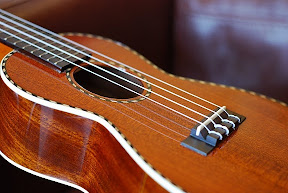
The Pono is certainly a pretty instrument with some extremely pleasing finishing touches. It is of all solid mahogany construction in the body and neck, and finished in gloss. The shape is traditional with quite a wide lower bout to the body and a slightly arched back to assist with sound projection. The grain of the mahogany is quite, quite stunning to look at. I cannot take a photograph to show this properly, but there is a real flame in the grain that glimmers when it catches the light. The top and back are nicely bookmatched and the grain in the sides runs parallel to the top and back also, something you dont see on my Mainland uke. The top and back have an ebony binding bordered with a thin strip of white which is perfectly finished with no flaws whatsoever. Turning the uke over and there is a similar ebony strip down the back and on the base of the uke which adds a very classy touch to the look of the instrument. The sound hole is surrounded by a genuine abalone ring. I am not normally a fan of too much "bling" on instruments, but this is about as blingy as the Pono gets, and I think it looks just right.  The real bone saddle is housed in a small and delicate looking ebony tie bar bridge.

pono mhc ukulele body

pono mhc ukulele arched back


Moving on to the neck we have a three piece construction, something that differs from K Brand ukes which will tend to use a single piece of wood. The neck profile is comfortable and ends with a nicely finished headstock which is faced with a piece of piano shiny ebony in which the Pono name is inlaid in mother of pearl.  The fingerboard is in beautiful dark ebony also, although it looked a little dry and washed out when it arrived. A very thin application of Fret Doctor oil soon sorted that and it now looks beautiful.  There are 19 nickel frets, all dressed perfectly with NO sharp edges at all. The fret markers are small and circular made of mother of pearl, and are repeated on the top edge of the fingerboard. The edges of the fingerboard are also trimmed with an ebony strip to hide the fret edges

pono mhc ukulele headstock


The ukulele tuners are geared and enclosed, and bear the Pono name on the back of each one - another nice touch though if I am honest, I would have preferred open geared tuners. That said, these are not heavy. They are finished in gold with very small ebony buttons which pleased me too - other uke makers take note - if you are putting geared tuners on your ukulele, please choose small buttons - otherwise the ukes look like Mickey Mouse!  These tuners are smooth and accurate and present no problems. The nut is also natural bone and is set and finished very neatly.

pono mhc ukulele tuners


Looking inside the body, I see the top and back are secured with standard looking kerfling. The bracing too looks traditional and also very delicate - these are not rough chunks of wood, but nicely carved to size aiming for the minimal amount of wood whilst maintaining structural integrity, making for a more resonant ukulele.

So to summarise the cosmetics - the ukulele is absolutely flawless in every respect. The differences from, say, the Mainland ukulele, are clear in the little details. The arched back, the real mother of pearl and abalone, the dressed edges to the fingerboard, the use of ebony and oh, that wonderful grain pattern.  The gloss is applied perfectly, with no pooling or small bubbles in crevices as I see on the Mainland. There are no glue drops inside the body either, and the only smell coming from the soundhole is the smell of wood. This level of finish on a high end K Brand ukulele would easily push the cost of your instrument over £1000, so it's extremely pleasing to see that level of quality at this price.

pono mhc ukulele back


But what does it feel like to play? Well it feels good in my hands, is light and nicely balanced. The fretboard is wonderfully finished allowing fast play, comfortably. Tuning and intonation all over the neck were spot on when I checked with an accurate tuner and as such I have zero issues in this respect. The finish is not "sticky" and the back of the neck is smooth to hold and move around on.

So, the biggie. Sound. Well its VERY nice. Sure, it doesnt have the absolute bang on clarity and sustain of a Hawaiian ukulele, but I never expected it to. Volume wise, its on a par with the Mainland but there is more harmony when strumming, more seperation between the notes and a much more chimey sound. It really does have a fizz to it when strumming, yet when picked it sounds really warm and full, meaning its a very verstatile instrument to my mind. This model has been fitted with Worth clear strings by the store as I am not a fan of the Ko'olau gold strings that Pono ship this uke with which will have some bearing on that. The sound is clear, and has good sustain. In comparison, the Mainland, whilst still a wonderful sounding ukulele sounds a little more "boxy" than the Pono, slightly more one dimensional. It's worth adding too that the Mainland I own is about two years old, so the wood will have opened up a little more. As such I can only expect the Pono to improve further with age.

How would I summarise? Well on sound alone I can't say there is a £200 uplift in sound over a Mainland ukulele, but that would be unfair on both instruments. Sound quality is subjective and does not improve pound for pound on a straight line graph.  A £1500 Hawaiian ukulele will not sound twice as nice as a £750 ukulele - that would be ridiculous. But pricing is about more than sound, but also looks and finish and in that respect, as pretty as I think the Mainland is, this uke is leagues above it in that respect. In fact it's easily the prettiest ukulele in our household now.  If you find the price a little steep, there are Pono ukes available with less "bling" and finish that I would expect to be nice sounding also, so would certainly suggest looking at those.

Do I have any gripes - not really. I have mentioned the tuners, but that is just personal preference, and bear in mind that I paid extra for Worth strings as I am not convinced Ko'olau should ship these with their own strings. I suppose a single piece neck would have been expected for the money, but this is a factory built instrument and I understand the reasoning. Those are, however minor gripes - the instrument looks great, plays great and sounds great.

In summary, I would consider this uke to be in the range of "as good as you will get without going to something handmade". I'm extremely pleased with it and so is she!

As a final word - it is worth me mentioning the hard case. These ukes come supplied with a Ko'olau branded hard case of really nice quality. The case has distinctive red stitching around the lid and is clearly not a cheap case with quality fittings, interior and handle. I would suggest that such a case would probably cost around £40 to purchase, so that £379 ukulele is probably better considered a £339 instrument.


pono mhc uke


5.9.11

Ukulele milestone

A HUGE thank you to anyone who has picked up a copy of my ukulele beginners book, but it hit a new milestone this morning.

It became the number one book in the Amazon UK music reference charts! It's also number four in all Kindle music books which ain't too shabby either.


Support from readers and those who have spread the word has been pivotal in the books success, and I appreciate that greatly. I'm glad it's no nonsense style has found an audience.

You can grab a copy at

Amazon UK

Amazon.com

Smashwords


- Posted using BlogPress from my iPad


3.9.11

Ukulele Ramblings - break through your barriers

Learning anything, whether it is a musical instrument or not requires dedication, effort and resolve. In learning you will always hit 'barriers' where you feel like you want to give up, that it's never going to work and that you have made a mistake. The ukulele is no different.


I repeatedly point out to beginners that the ukulele is an easy instrument to learn and I stand by that. In my opinion it has one of the shallowest learning curves of any instrument meaning most beginners can get something meaningful out of it in weeks, days, or even hours and minutes. But it takes a considerable period to become proficient and unless you are a total natural, you will hit walls that you think are impossible to break through. The trick is to stay dedicated and work through them!

The first barrier many people hit, particularly if they have never played strings before are the sore fingertips. This is extremely common and something that only eases with more playing as you need to build up harder skin in the form of callouses to overcome the pain. But it should be short lived and WILL improve. If you are struggling though, check out the advice Here.

Another cause of pain you may encounter will be aches and cramps. Again, perfectly normal. You are asking your fingers to move and stretch into unnatural positions and your muscles and tendons need to learn. In these cases, if you are in pain, don't play on regardless or you may cause some more serious damage. Take a break! Sure, only continued practice will stop the pain occurring, but you need to listen to your body's signals and know when to ease up. You may want to accompany your practice with finger stretching exercises you can find Here.

Moving on to the other hand, the next most common barrier is getting comfortable with strumming. For many, it is a real struggle to get your playing flowing naturally. The biggest mistake many make is to try to learn something far to complex before mastering more basic songs and patterns. Keep it simple when you are starting out - if you enjoy your uke you will be playing it for years. You have all the time in the world to learn that favourite song with 15 chords and a tempo of 100 miles per hour! The first strum you need to master is just some basic up and down in a steady rhythm. Consider investing in a metronome if you struggle to keep time. It may sound boring but if you don't master a basic rhythm, you will always struggle.

And putting all this together, you will continue to hit barriers, even when you become an accomplished player. I still hit them when trying a particularly complex strum, or chord change. The answer, as with even the most basic barriers is to keep at it. If it's not working for you, take a break and play something else, come back to it another day.

I hope this inspires and supports new players who are reading. You are not alone, and we all go through what you are going through, just keep pressing on and before you know it, you'll be playing freely and advising other new players how to break their own barriers!

Good luck as always, and enjoy it!


- Posted using BlogPress from my iPad


2.9.11

Improved ukulele profile

You can't knock an article plugging the UOGB!

Improved ukulele profile - Leisure - West Sussex County Times

Coming soon on Got A Ukulele

Still on summer break with my children, so blog posts are less frequent at present but got some cool posts to share with you in the coming weeks to satisfy your ukulele cravings! These include

- a review of a new uke in this household - a Pono Pro Classic, Mahogany Concert ukulele (picture below)


- more interviews, including a chat with a ukulele act very well known around the globe!

- I will be expanding on my recent string report on my Kanile'a and providing reviews of all the strings I use on various ukes in detail. I figure that string reviews are not the most common, yet it's something new players are keen to know about.

- more Ukulele A to Z and Beginners tips

Contributions to Got A Ukulele always welcomed.

See you soon!

- Posted using BlogPress from my iPad