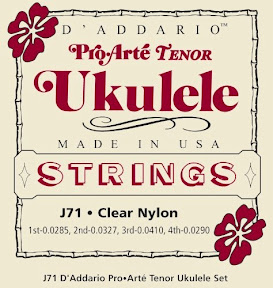
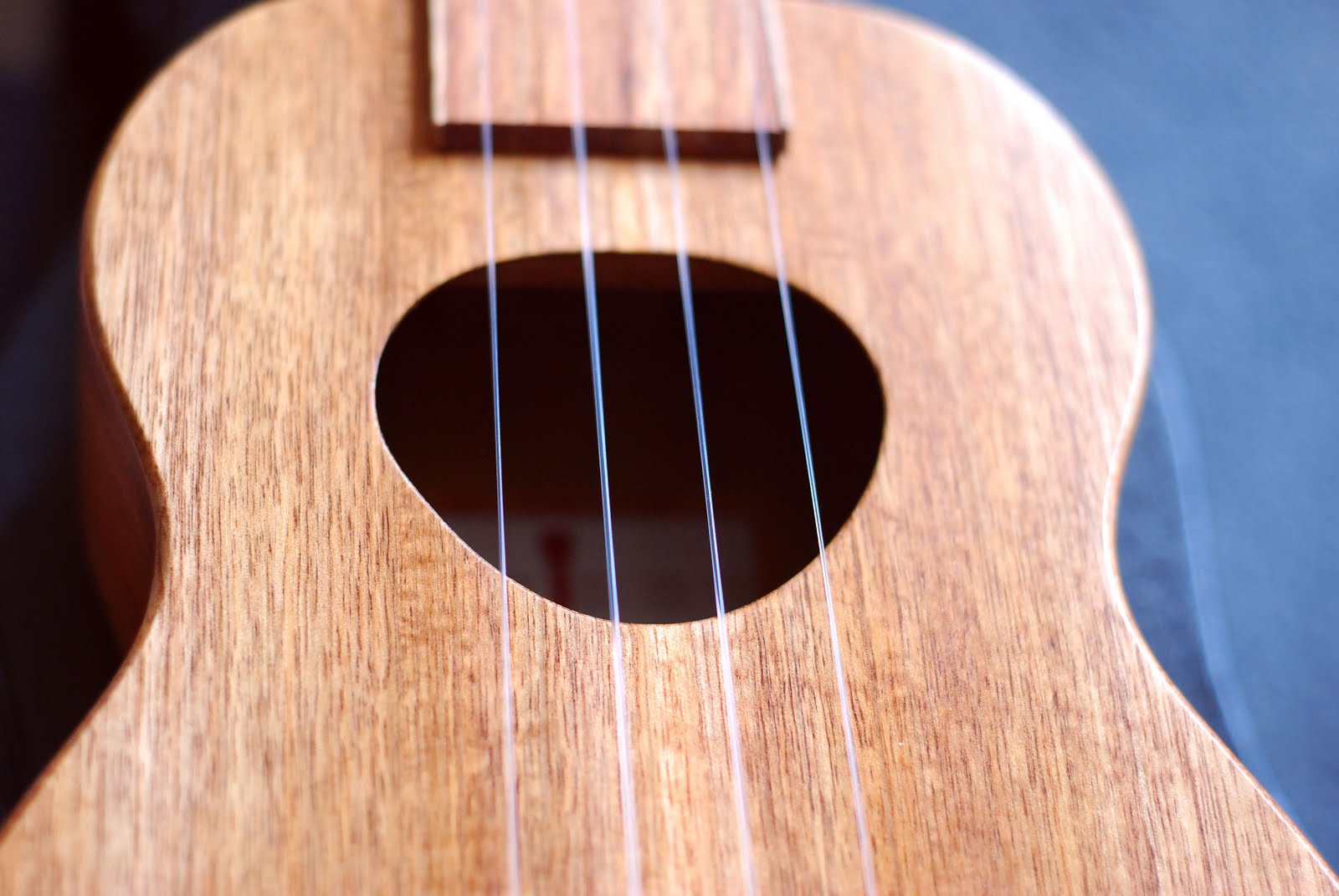
Having already reviewed ( and been delighted with) my Kanile'a K-1 Tenor, I have since been keen to test it with a set of D'Addario Pro-Arté strings.
The Pro-Arté strings are D'Addarios premium ukulele string line, of laser selected all nylon strings. I am not normally a fan of pure nylon strings but I had read great things about this set and how they perform. But they are unusual for a simple reason - they are actually classical guitar strings!
I understand that the pack, whilst branded on the outside as ukulele strings often confuse many people as the string sleeves are marked as guitar strings, and are labelled as E,G,B and E!
So, what's the deal? Well, they are indeed classical strings, and they are the favoured string selection of a certain Jake Shimabukuro for his Tenor uke. He selected these himself from the D'Addario stocks and the public demand then grew so great that D'Addario packaged them in ukulele branding as a ready made set!
They are a high G string set, and if you buy some and are confused the strings are labelled as follows with the appropriate uke string
J4401 E-1st .029" - for the uke G string
J4603 G-3rd .041" - for the uke C string
J4602 B-2nd .033" - for the uke E string
J4601 E-1st .028" - for the uke A string
Now, you will notice that the pack contains two high E guitar strings, but they actually differ slightly. The E that is used for the G uke string is actually very slightly thicker than the other, and whilst all the others are labelled Hard Tension, this one is an Extra-Hard Tension string. I presume that is to assist in making that re-entrant G string chime.
Stringing them up, and the guitar provenance is obvious, they are very long and much thicker than any other uke strings I have played. More on that below.
So after much stretching and tuning, I've been playing these for a couple of days now. You may recall that i felt that my Kanile'a really shone (strung with Worth strings) when fingerpicked. Well the D'Addarios are equally as good. They are not as bright sounding as the Worths which have a zing to them, but have more sustain and a richer tone to my ears. There is also a clear improvement in strumming tone. Don't get me wrong, strumming before on an instrument as good as a Kanile'a was very sweet, but these new strings seem to bring even more clarity to the range of tones.
Volume wise, its a tough call. I think overall the volume is comparable to the worths, but with a little less treble and a touch more bass.
So all sounds good. The quality of the strings is clear with superb clarity of sound. But I suppose it does come at a price. I suppose it serves to make the uke sound a small step closer to a guitar sound, something I know many users dislike. I'm in two minds myself.
But newcomers should really be aware of that high tension and thickness. Luckily I've played guitar for over 20 years but if you struggle with sore fingers you may find these hurt the fretting hand tips. Extra tension also makes them harder to fret, but also I found I needed much stronger picking to get decent volume. I have long fingernails, but suspect someone trying to pick just with tips may struggle to get volume from the instrument.
So in summary they are clearly a very professional grade string, but that means they come with a small health warning. I adore the clarity and richness as the strings harmonise together, but miss the zing that the Worths gave me. As such, undecided at present but certainly a string I think any tenor player should try.
I am always really happy to help out promoting ukulele festivals and get togethers, especially those that are aimed at beginners, and what better than a festival aimed at children.
Well I've had my Koaloha soprano for a good few days now and I have been playing it constantly. I wrote an initial review of the instrument here, but as promised I said I would let you have a more detailed review of the sound once I had played it more.
Well, the uke has continued to totally impress me. The volume and projection are quite staggering for a ukulele of such a diminutive size, and played side by side with my Kanile'a tenor, it's actually the louder of the two. If you are playing with others there is no way your sound will be lost, and in fact I proved that last night playing in a jam with four other ukes (a concert, a tenor and a baritone) AND a Cajon drum and all agreed that the Koaloha was providing the clearest voice through the mix. Almost like the lead singer of the band!
Despite what I thought about the uke when it arrived, that I would prefer the Kanile'a for fingerpicking, I've actually really enjoyed picking this little uke. Fingerboard space actually feels quite generous, and the impeccable setup helps, but again the volume and clarity of sound help in this respect. Earthy it is not, but picked with nails and the uke really sings and sustains well. I suppose the best way to compare it to, say, my tenor is that if the tenor is equivalent to Bob Dylan picking an acoustic guitar, then the Koaloha is the lead electric guitarist on a screaming guitar solo! It's bright and punchy!
It's not all about volume though as the uke is equally happy being played softly, or gently thumb strummed. This is where I find that cheaper instruments tend to suffer as they tend to lose their projection and tone when played soft. The Koaloha on the other hand still wants to sing and is still clear across all strings. And that is a feature of this ukes sound that appeals so much. Whether strumming or picking, whether playing fast or slow, hard or soft, but every note in your playing comes through with bell like clarity.
It's also extremely easy to play. I mentioned the neck and action above and they certainly allow quick finger work with the fretting hand, but it's also a very light and comfortable ukulele to hold. I think it helps that the lower bout of the body is slightly wider than the traditional soprano shape uke, but this is, without a doubt, the easiest ukulele to hold out of the models that I own.
So, I'm clearly delighted and suspect this will become my 'go to' ukulele, particularly when jamming with others. HIGHLY recommended.
Another new ukulele day, and another Hawaiian uke for me to share with you. This time it's by Koaloha and the model is their entry level Soprano, called the Pikake.
This arrived during this week from the French ukulele store Musique83. Their service has been absolutely superb and I would highly recommend that you give them a try. Patrick who runs the store is excellent. He shipped this to me quickly and well packed and it came with a hard case too!
The Pikake (Hawaiian word for Jasmine) is a fairly no frills Soprano uke that comes in a semi gloss finish. It differs from the standard soprano in that respect, with the standard coming in gloss. The other difference is that the standard soprano doesn't have a straight cut end to the fingerboard, rather it has a carved end. I wanted the pikake as I am not a huge fan of gloss finishes, particularly not on a high end wood like this one which is made from Hawaiian Koa. Koalohas are made by the Okami family in Honolulu, where the business was started in 1994 by Alvin Okami. Each uke is made and finished by hand.
The construction is impeccable. The body is all solid, bookmatched Koa with a beautiful grain, particularly the sides which show some deep red banding. The soundhole is shaped and not round, something that Koaloha have trademarked and call the Musubi shape. A further nice feature on the top is the carved hardwood tie bridge which shows the name of the brand. The bridge saddle is made of TUSQ.
The neck is not made of Koa, but is Sapele, but is still rather pretty with a spotty grain that looks great at the headstock. I believe you can specify the same uke with a neck made of Koa too if you get hung up about wanting your instrument to be 100% Hawaiian Koa! It's a one piece neck and I love the way it is carved, particularly the heel which has an angle to it's back, and slight curves where it joins the body. Little details like this impress me. The neck has 12 fairly chunky nickel frets and I believe is also made from Sapele but without the semi gloss finish. There are three white plastic fret markers and the edges of the fingerboard are bound with thin strips of Koa to hide the fret ends - another nice touch. The neck feels smooth and quick and the frets are finished perfectly with no sharp edges. The nut is also made of TUSQ but a little rough looking with slots rather too deep for my liking. I would have thought that the nut didn't need to be as big as it is.
Moving further up the uke we come to the feature that makes Koaloha ukes stand out - that five pointed crown headstock. It really is stunning looking and gives the ukulele real individuality. The Koaloha logo is engraved deeply into the face of the headstock.
Tuning is achieved via some very high quality friction tuners in a deep red marbled colour, each one laser etched with the Koaloha logo on both sides. I was pleased with this as had they been screen printed they would eventually wear off. Many people dismiss friction tuners, but I personally prefer them as I think they suit a uke better than geared pegs. The quality of these is excellent (the best I have come across) and they tune the uke just fine.
Overall the construction is excellent, and the uke is also extremely light yet strong. Looking inside the soundhole is interesting. The top and back are not connected to the sides with any kerfling (the strips of notched wood inside most if not all other ukuleles to attach these parts, which leaves you wondering how the thing stays together. The answer is down to the bracing which, unlike other ukes which use strips of wood on the underside of the top (and sometimes on the back) the Koaloha uses a brace that runs under the top, down both sides and across the back in one piece. It's hard to describe but if you imagine a rectangular piece of wood with the center punched out you may get the idea. This system allows the uke to be light in weight but very strong. I read reports that you can stand on this uke on its side but I don't intend to try that!
Also inside the uke is the Koaloha label, and embossed into the end of the neck block is the date of manufacture. This is a nice touch also, as this is an instrument which will hold value. Many years in to the future this date means no confusion as to what vintage this instrument is.
Strings wise, they look to me like Worth Clears, but I had a word with Alan Okami at Koaloha and he advises they are their own selection matched to individual ukes. As far as I am aware they are not available to buy retail yet but they are working on this. Many Koaloha players I speak to suggest they move to Worth Clears when they need a string change.
Playability is very, very good. The ukulele is balanced to hold and the action is perfect for my playing. Intonation all over the neck is excellent too with a beautiful chiming harmonic at the twelfth fret. It's a uke that begs to be played and is great fun.
Sound is what this uke is really all about though, and I will report further on sound when I have owned the uke further. Initial observations though are extremely good. Firstly, the thing this Soprano is famous for - the volume. Boy, does this uke pack a punch! I am staggered at how powerful a sound this uke can produce. There is no booming and the sound is clear but massive. Tone wise, being a soprano you are never going to get the same richness of tone as you would in say my Kanile'a Tenor. But it sounds like the perfect classic soprano ukulele. There is a chiming bite to the tone and the clarity of each string is impressive. Every note of a chord when strummed just shines through, and some hammering on and pulling off within the chords during strumming really comes through in the sound. Fingerpicking is not as satisfying as on a tenor but still sounds great and clear with a really sweet tone. Overall this has exceeded my expectaions.
Any gripes? A couple.
There is the nut which I think could be finished better, but the fret markers are a let down. They are very rough around the edges with signs of filler and look quite messy. That surprises me when you consider the many other quality touches elsewhere on the instrument. Sure, they make no difference to the sound, and anybody watching me play would not spot them, but I know they are there and for a pro level instrument (albeit an entry level pro) it's disappointing. Further, if I wanted to be REALLY picky, I would say that there are some glue spots and seepage inside the body on wood joints. Again, this doesn't affect the uke at all but I know some ukulele fans get irritated by such things (personally I don't..)
But those aside, the whole ukulele is just wonderful and I believe is, frankly, all the soprano you would ever need. It's got a great voice, great looks and great volume. I love it!
SCORES
Looks - 9
Fit and finish - 8
Sound - 9.5
Value for money 9.5
OVERALL - 9
STOP PRESS. I have since written a little more about the sound having now been playing that for several days. You can read about that Here
I was having a discussion with friends recently about stores I have had good service with. There are many shops out there, but some have a real specialism with the ukulele and as such provide expert advice. I thought I would share my favourites with you and let you tell me yours.
Bear in mind that I am based in the UK so for shipping cost and import duty reasons I havent risked ordering from the USA. That's where you come in. Add your comment to this post letting me know your favourite store and why they offer good service.
So, on to my favourites...
Southern Ukulele Store - probably the best known uke seller in the UK and they must also have the largest stock. They are based in Bournemouth and managed by Paul Tucker, a uke player himself, their advice and range is wonderful. Everything from cheap entry ukes to beautiful handmade instruments. They also have a great range of strings, and I think their prices are competitive. Speak to these guys and you know you are speaking to ukulele experts!
Eagle Music - a great store based in Huddersfield that sell a range of folk type instruments. They don't have as wide a range as SUS, but do carry some nice ukes and are the approved UK dealers of Mainland instruments. Their service really shines, and if you pick the phone up to them you can speak to an instrument lover who really understand their products. I had a problem with one instrument and their after sales service was superb.
Highly Strung - A wonderful little shop based in Wantage that offer the same expert advice from an owner (Nigel) who knows his instruments. Their range sticks to the beginner to intermediate category, and I recommend them often as being the uk's most reliable stockist of the Makala Dolphin.
Musique 83 - moving in to Europe we find this excellent store in Giraud, near the south coast of France. Their range is huge and includes many high end ukes at very competitive prices. Even with shipping you may find their prices can't be beaten. They offer a nice service where each uke is photographed in detail and they guarantee to ship you the actual uke you are viewing in order that you know what grain pattern you are getting. I recently had a tech support issue with them and Patrick at the store handled it perfectly. In fact it was beyond perfect. Highly recommended.
Thomann - A German large volume dealer of a bewildering array of musical instruments. I don't often recommend this sort of store as you can't speak to an actual expert in their field, only sales reps. It's the reason I would never recommend buying a uke from Amazon. They also ship boxed as the ukes arrive from the factory, ie no set up. As such I would not recommend them for cheap ukes unless you are prepared to adjust setup yourself. So why are they on this list? Well, their prices are good and they ship the ever popular Eleuke models. Delivery is quick and reasonable and the instruments come in the best packaging I have ever seen.
So those are the stores I have had the best experience with. I would be delighted to hear about yours!
The blog is on a bit of a go slow at the moment as I have a couple of weeks off work to spend with my children. Ukulele playing is continuing though and had a great jam last night with good friends.
Some good stuff in the pipeline though including...
--More product reviews, including an App and a review of my new Koaloha Soprano which looks something like this
-- two new and quite exciting Got A Ukulele interviews
-- more beginners tips, ukulele ramblings and song chords
And, of course if you have any ideas, suggestions, or if you want to contribute any articles please do get in touch!
More ukulele ramblings, this time on a subject close to many people's hearts - money.
As with most musical instruments, prices of ukuleles vary considerably. You can start with a £20 instrument, or you could spend thousands on a hand built luthier made model. But is it wrong to go either way?
If there is one thing I cannot bear, it is musical instrument snobbery, usually an assumption that a cheaper instrument is an indication that the player of said uke is either not serious, or worse still, cannot play. What utter nonsense. We all have our limits and live to our means, and that means nothing about ones love for or ability with a ukulele.
I have already blogged about uke prices, with advice on the pitfalls to avoid (and, sadly, at the cheaper end of the scale, there ARE pitfalls). You can read that Here.
So what does one get for the money? Well, certainly in most cases under £100 you are getting a laminate wood instrument put together on a production line in the Far East. Quality control in some cases can be good, and in some others appalling to the point of unplayability. £100-£250 and you will start to see solid wood models, but in most cases put together in the same Far Eastern factories. Over £300 and you start to move into hand made and luthier models where woods are selected and matched for the particular instrument, and flaws rejected. Those hand made models will range between about £300 and £1000 for standard specification (ie, no bling). Beyond that the sky is the limit with prices, but bear in mind you are then, in the main, simply paying for extra binding, top grade woods and the like. The ukulele SOUND will not, in my opinion, be twice as good on a £1500 instrument as it would on a £750 instrument. Of course, if you have the means, then why not? There sure are some pretty ukes out there.
But these upper levels are clearly beyond the reach of most people, and many new ukers will settle for something under the £100 mark as a first instrument. To illustrate my dislike to instrument snobbery, despite owning some high end ukes, I regularly give my support for the Makala Dolphin uke. It's an absolute marvel of an instrument when properly set up, for about £29. Not only do I recommend them, but I still play one. Why is that?
There are several reasons. Certainly I would think twice about taking an expensive uke camping or to a rowdy party, but in my budget, the Makala is replaceable. But that is slipping towards the snobbery a little, as it seems that I am keeping my jewels at home and suggesting that I only have the Makala to throw around. That is not the case. When you move into the high end bracket of ukes, what becomes immediately noticeable (aside from the usually impeccable construction and finish) are two things. Tone and sustain. By crafting an expertly built uke from the best tone woods, you create an instrument that can deliver a full rich sound that lasts. An additional benefit is volume, but that isn't to say it is the preserve of high end ukes - try playing a Flea! But that rich sound is what you are paying for. For many though, their uke playing is focussed on strumming well known songs, often with other people in jams, bands or clubs. It is on these occasions when the other element that the ukulele is noted for comes through - rhythm. If you are strumming a chugging pop song with four or five others, particularly if you are singing along, that richness of tone would soon get lost amongst the collective sound. What you need is a uke that can join with the rhythm, and in those cases a cheaper uke works perfectly. It is on those occasions (which are the most common occasions for me to play uke) that I either play my Makala, my Flea or my Fluke. Their tone is not rich, but they are loud, and sound like ukuleles!
So why then do I bother to own an expensive uke? Well it's my hobby and my passion, and for moments when I am alone, playing to myself, I want something that sounds sweet to my ears and that's the only reason for this uker. Sure, there are reasons others will have - if you are looking to perform solo, particularly finger style, you may want to consider a sweeter uke. But in the majority of cases the other end of the scale is perfect. I would wager that Jake Shimabukuro would have a great time strumming with friends on a Makala or something similar.
So don't get too hung up on it. Do, of course be careful and ensure you buy from a reputable dealer who can check the setup, but don't fall into the trap of snobbery. Oh, and if you come across a uke player who turns their nose up and sneers because they have a more expensive uke than you, remember - they are not the sort of player I want to associate with, and i'd humbly suggest, neither should you. Thankfully though, in the uke community (unlike with guitars where it is rife!) such people are few and far between.
Well, I have been in possession of my beautiful Kanile'a K-1 Tenor uke for almost a couple of weeks now, and I thought it was worth giving you an update to my review having had chance to play my uke every day since it arrived!
I dont need to go into the details of how it looks again, you have read that in the review, but I will say that every time I open the case I smile - this is a beautifully made instrument. What I wanted to share with you is how it plays and sounds in a little more detail.
At the time of my first review I had put Worth clear strings on it and I am still working with those. The tone from this ukulele is incredibly sweet and has both a nice chime and an earthy quality to it. Making this step up to a serious professional instrument really shows and the volume, clarity and breadth of the tone this creates compared to my other ukes is night and day.
Strumming I am still working on. Not only is this my first tenor, but those build qualities do affect the way this "works" when strumming it. At the moment I am still experimenting with my playing style and strumming position, but I do find that if strummed hard the instrument can overdrive or boom a little. This doesn't concern me at all at this stage for a couple of reasons. Firstly, I have come to this ukulele from models that are nowhere near it in terms of quality, The way the company have constructed this uke, in particular the quality of the woods and the clever bracing system means that this instrument creates decent volume with very little effort. As I say, I am working on my strum style and frankly am strumming it harder than is needed. The other reason may be down to the strings, and I intend to try various brands on this uke until I find the type that suits my ears best. Next to be tested on the Kanile'a are D'addario Pro Artes.
That isn't a gripe at all, as strumming the uke creates a shimmering full tone that is hard to describe. The best way I can put it is that in any stroke, the sound that is created is full and every single string is noticeable in the mix. I don't have another uke that plays that way.
But where I am most pleased with the Kanile'a is in fingerpicking. I have never been a big (or great) picker of ukuleles but do play guitar and like to play in that style on those. The reason I never really have on uke is down to the sound and the pleasure it can (or can't) deliver to me. With my other ukes, as much as I love them, a lasting sustain is just not there and I prefer them for strumming. Don't get me wrong, there is 'some' sustain on my other ukes, but nothing that lasts, and bearing in mind I fingerpick on guitar, I just don't find they cut the mustard, and fingerpicking ends up sounding too staccato for my liking. The Kanile'a changes that completely. This instrument has significant sustain and a beautiful clarity to any plucked note. Add to that the fact that the intonation all over the neck is perfect, and that makes this a sublime instrument to play in fingerpicking style. During the last week I have found myself creating picked arrangements of many songs I usually strum. In fact I am getting huge pleasure just creating my own picking progressions. It sounds silly, but its one of those instruments that almost plays itself! Of course being a Tenor, that wider spaced neck helps in this respect, but the action and setup by Kanile'a is also a big part of it.
So, in summary, I am absolutely thrilled to have this ukulele in my collection. It has really opened my eyes (and ears) to the level of quality a handmade Hawaiian ukulele can deliver. Frankly its jaw dropping.
This uke is certainly going to be my go to uke when I want to fingerpick, it is just so sweet. Yes it is expensive, but if a uke like this is within your budget I can heartily recommend it.
I thought I would start a series of ukulele ramblings. Not tips or tricks, but just general thoughts about the ukulele as an instrument and what it means to play one. First up - say hello to the All Inclusive Ukulele!
It never ceases to amaze me how diverse a crowd the ukulele community is. We have people who play traditional music hall style and people who play rock. We have folkies we have jazzers. We have those who like to sensitively finger pick and those who enjoy nothing more than strumming out the latest pop songs in simple three chord style. We have those who like to play alone, those who like to play in pairs or trios, all the way up to playing with dozens if not hundreds. But the important thing is this - very few players I know are pigeon holed in just one area. In fact many players, including myself like to do ALL of the above - the uke really is that versatile. Add to that the fact you will often find players who prefer a certain style being totally welcoming of listening to or playing along with something outside their comfort zone. I'm not the worlds biggest pop fan, but what the heck, playing Jessie J's 'Price Tag' on a ukulele is FUN!
And what about skill level? I have never made any bones about the fact that I am a mere average player. Sure, I talk a lot about the uke and made it my mission to help out players, beginners in particular, but my playing is just average. Rhythm is my thing and I think my skill lies in getting a good chunky pattern going with a uke, but my fingerpicking leaves much to be desired. But again, a lot of uke players I know fall in to that category but still get such an enormous amount of pleasure from it. Sure there are the true modern ukulele greats out there who make sounds with their ukes that leave me speechless - just check out anything by Jake Shimabukuro or James Hill if you want to see examples, but few reach those heights (not that one shouldn't try). In my experience though, I have jammed ukulele with friends many times, often in front of an audience. Some players are more accomplished than I am, and some players are just starting out, capable of only two or three simple chords and still struggling with sore fingers and how to strum naturally. Yet, when I'm playing and look around, not only do I see happy listeners, but I see happy players too. From the accomplished to the struggling, everyone has a smile on their face. Take a look for yourself, join a jam or a club and you will see the very same thing.
And of course we can't ignore price. Yes, there are some shocking cheap instruments on the market from makers jumping on the rise of the uke in recent times, but buy from a reputable dealer and one can start with ukulele for about £25 a £30. I know because I own one. I have had as many happy times playing a cheap Makala Dolphin with friends as I have playing an mid priced Mainland or expensive Kanile'a. I'm not going to insult your intelligence, of course the higher end instruments DO sound better and so they should, but that doesn't mean a player with a cheap uke is unable to have fun jamming with friends playing instruments that cost hundreds of pounds more. I still pick up my Makala regularly and would have no qualms taking it to a local uke jam. Name me another instrument that suits so many budgets?
So there you have it three good reasons that show the inclusive nature of the ukulele. When you start to play one you join a community that is only happy to help regardless of your ability, your music tastes or your choice of instrument.
But I'll end with a more subtle example that demonstrates the uke as being an inclusive instrument. When I was going through my first stages of school we were forced to play the recorder as a class instrument. I despised it. I've since read a variety of theories as to why the Government chose to push it, such as price and it supposedly helping kids get along with piano notation. Sadly, not that many kids in modern times have families with the funds to support buying a piano, but my gripe with the recorder was that it was stuck in your mouth. Nobody can sing while playing it, and for children, singing is fun that everyone can join in with. So if you are the child, like I was, with a dislike for the recorder you are stuck with it no matter how hard or boring you are finding it. Now take the uke, which is being introduced to junior children in some schools now, as it has been in Canada already. It's cheap like the recorder, but bear in mind that there is no way all kids will enjoy it or will progress equally, just like the recorder also. Some will struggle, BUT it's not stuck in their mouths! Introduce singing together with uke and the whole class can come together with mixed abilities, but all still take part. I recently discussed this very subject with a music teacher and that is exactly what they found in class. Some kids struggled, but made up for it by singing, some liked strumming but sang less and of course there was a whole spectrum in-between. A class came together as one.
Ukulele Underground – http://www.ukuleleunderground.com – In my opinion,
Highlighted by 3 Kindle users
I personally like the Brown Mediums, labelled as BM (well... duh!). These strings are thinner than Aquilas, and are smooth in finish (so slippy).
Highlighted by 3 Kindle users
the entry level models from Bruko. These are (amazingly) handmade in Germany, are made completely from solid wood, and start at around £100.
Highlighted by 3 Kindle users
The safest option I can recommend is to buy a Flea ukulele made by the Magic Fluke Company. They are, due to their construction, almost guaranteed to be set up well.
Highlighted by 3 Kindle users
“the gift that came here”, from the Hawaiian words uku (gift or reward) and lele (to come).
Realised that I had never given my readers my review of the Kala KC02 clip on ukulele tuner, so here we go!
The KC02 is a very simple tuner that works in the same way as the dozens of these that exist. I'll be honest, when I was in need of a new tuner as my previous Cherub broke, I probably did pick this because it was branded Kala. That said, obviously Kala dont physically make these, they just badge them and its merely a generic Chinese model.
It has the usual clip with padding protection to clip on the headstock and a clear LCD crystal display. There are no other switches on the tuner other than a large on off button at the base. This (obviously) switches the tuner on, but tapping it again cycles through the functions it offers, namely C tuning, D tuning and Chromatic (which basically can be used to tune anything). It is made of plastic with a slight rubberised coating to it with the Kala logo in red screen print.
Like many other tuners, when clipped on you pluck a string and an LCD needle moves to register the note, and when central (pointing at 12 o clock) turns green to signify the string is in tune. It also shows the note that you are tuning in the top corner. Sadly, unlike other models that use a variety of colours, this moves only between a pale blue that is used to signify a string that is either sharp or flat, and green for "in tune". The display is clear enough, but it is small and because of that the needle cannot show an accurate number of positions for each note.
And that really is it. Its a simple tuner, and I suppose it works ok. The gripes I have though are that this tuner is still selling for a price (circa £13 - £15) for which you can get superior tuners that offer much more.
Lets look at what is missing
- no multicolour display
- no ability to "tune" the tuner to another frequency or instrument
- no microphone option meaning it only works clipped on. (Some tuners have a feature where you can set it on a table and tune the ukulele acoustically via a microphone)
Above all else though, I don't actually find that this tuner is particularly accurate. When the notes are "on", sure the uke is fairly well in tune, but there seems to be quite a lot of "give" or "play" in what it considers to be in tune. I suppose it is probably a feature of the small and fairly simple display that doesn't allow it to show a needle that is very accurate, but you should bear that in mind.
To add to that, I also don't find it particularly sensitive either and you need to really pluck the strings quite hard to register them. This is not only bad practice as tuning a stringed instrument works better when you pluck a note cleanly, but it also tends to confuse the tuner and have it throw up some odd notes nothing like the one you plucked.
Oh, and the battery cover is rubbish and has worked loose meaning most times I take it from my case, the cover has fallen off and the battery fallen out....
For my money though, I would shop around and look for more features for the same money. My top recommendation for a tuner that still amazes me at how sensitive it is, look no further than the Snark range of tuners. They are hard to beat in my opinion.
The piece of the ukulele, over which the strings run a the bottom of the instrument. Whilst they are sometimes a moulded one piece item, the saddle is most commonly a thin strip of hard material ranging from plastic to bone and are set in a slot in the wooden bridge. Accurate saddle placement provides accurate tuning by ensuring the correct Scale Length (see below). Accurate height of the saddle ensures the correct action and intonation.
SCALE LENGTH
The measurement along the length of the strings measured between the nut and the saddle. This length needs to be accurate in relation to the placement of the frets to ensure accuracy in the notes being played. The top of the 12th fret always denotes the exact halfway point of the string.
SETUP
The general term given to the adjustment of various elements of the ukulele, in particular the nut and the saddle to provide optimum playing feel and accuracy.
SHARP
The term given to a note that is sounded higher than its normal pitch.
SLOTTED HEADSTOCK
A traditional method of finishing the head of the ukulele. Rather than having tuning pegs running through the head from underneath a slotted headstock has the pegs running in to the instrument from the side, with the strings running in to the slots to be wound around the pegs.
Slotted Headstock Mainland Ukulele
SOPRANO
The smallest of the four standard ukulele sizes. This is the traditional ukulele size and is tuned GCEA with a high, re-entrant G string
SOUND BOARD
The term given to the flat piece of wood that makes the top of the body of the ukulele and holds the bridge and the sound hole. Also simply called the "top" of the instrument. The soundboard creates the sound a uke makes when strummed by vibrating.
SOUND HOLE
The hole in the soundboard or top of the ukulele, usually directly under the strings that provides projection of the sound created by vibrating the top of the instrument
STRUMMING
A style of playing which involves running the fingers over all or some of the strings in a rhythm
I am pleased to tell you that I have just completed an interesting interview with a uke player and builder who is becoming increasingly well known in the ukulele community. Say hello to Darryl Cursley of Cursley Ukuleles.
Darryl and I hooked up as part of the UK uke community some time ago, and he is both a ukulele bass player in the Mother Ukers and a ukulele builder of rapidly increasing renown. In particular he enjoys sharing the development of his ukulele projects with the wider world and is and extremely popular “follow” on Twitter (@cursleyukuleles) and Facebook, on which you can see excellent photographs of his ukes as they develop from raw wood to finished instruments. He is a beginner builder, but does have a fair few under his belt now and the quality is just astounding.
A fine selection of Cursley Ukuleles. The Butterfly Tenor far right was built for his wife! - Picture credit: Darryl Cursley
So, how did you start out with the ukulele?
I got bought a £20 uke for my birthday by our good friends Sandie (@funkychoir) and Phil (@fingersphil) for my 37th birthday, (I'm 38 and a half now) I was chuffed to bits, hardly put it down, traded it in for a better uke and that was it really..
I'm a bit of a sucker for knowing what ukes people have owned Darryl – can you tell us what ukes you've bought over the years?
Ukes I've bought? Well, that's a simple answer.. Surprisingly, its just one.. A Kala acacia tenor, that's it. I bought it to take some measurements for the first build and generally to get the feel of a uke, how it played etc.
What was your background that gave you the skills to start making ukes?
Although I've always been a carpenter, I'm a roofing carpenter by trade, so have only ever used huge timbers and a circular saw... I'd never attempted any fine carpentry before building the first ukulele.. That being said I've been working with my hands for 20 years so I have an excellent grasp of hand tools..
It must have been daunting starting your first – how did that go?
The first build went great! It came around in a weird way, I was in the Southern Ukulele Store (in Bournemouth UK) talking to the manager and my buddy Paul Tucker (@LuapRekcut) about ukes and he was showing me a uke a guy had built on the Pete Howlett weekend luthier course. The first thing that struck me was how simple it was, and secondly how much Paul loved it. He then told me how much he'd love a handmade uke of his own... Also at this point I'd had an offer from an excellent local luthier by the name of Lee Norris to give me lessons in instrument making (Link to Lees site here )I took him up on his offer and told Paul to watch this space. From the word go I paid every week to go build the first ukulele with Lee, so once or twice a week I'd go and listen, do what he told me and he'd also set me homework to complete for the next lesson. I still have lessons with Lee, I can build a lovely uke now but the depth of knowledge that man possesses is unbelievable. He could lecture on any instrument built in the last 1000 years, then build it, and then play it perfectly... I'll probably always have lessons with Lee.
Paul Tucker of the Southern Ukulele Store with his Cursley slotted headstock Tenor uke made from Yew - Photo Credit: Darryl Cursley
I know it must depend on the amount of 'bling', but roughly how many hours go in to making your instruments?
That's a toughie. As I build around my day job and life, I don't have a huge amount if momentum to my builds, I tend to spend more time thinking about what to do than doing it, if you see what I mean. I know at the moment I spend maybe up to 80 hours on each uke, maybe more. I like things that are perfect, and therefore assume everybody else does, and if anything in the entire world should be perfect, it should be a handmade ukulele. The amount of hours I spend on a single uke will drop as I gain more experience, but I'm not prepared to sacrifice even 1% of quality for that. They will take as long as it takes to get them perfect.
Probably a difficult one, but what was your most satisfying build?
I can't say. You don't point out your favourite kid do you? This is a little like that to me, I adore elements of each of the ukes I've built, the back of the cherry butterfly tenor, (the bookmatch and finish on that is something else) the headstock on Pauls yew tenor, I just can't choose. I am just starting a build that could be a candidate though, Tony Caseys soprano, now that, is going to be an awesome build! The level of forethought that's gone into the uke already is gonna make it a winner.
You have told me that you like to experiment with unusual woods, and English woods – what are your favourite materials, and what do you think they bring to the finished instrument?
Another difficult question for me. As to what different woods bring to builds I'm really limited in first hand knowledge as I've only worked with a few woods, Yew, Walnut, Cherry and Lacewood. The Cherry is really bright sounding and beautiful, the Yew has a warmer sound and the Walnut produces a clear tone. As for the woods I use, I'm using European woods, or English woods. I fail to see the point of using woods like Koa (this is where I may fall in popularity very quickly!) The Hawaiians use Koa and Acacia because it's their local wood, but it's not ours. We have beautiful woods available to use and it just seems ridiculous to be flying woods halfway around the world for no reason. You see the price tag on a ukulele when you buy it but that doesn't inform you of the cost to the planet. Don't worry, I'm not an Eco warrior or anything but @DaisyUkulele and I recycle, grow our own fruit and vegetables, and generally try to be conscious of our environment. You can have a beautiful and different ukulele without having to impact the environment "Maaaaan” *does peace sign*
Cursley Cedar topped, walnut back and sides Soprano - Photo Credit: Darryl Cursley
I ask everyone this question, but what is your best tip for a new ukulele player?
Best tip for a new uke player? Hmm.. GO BUY A *&%£ING TUNER.. or something like that.. Less sweary and shouty probably.. But I would look serious when I said it.
So, where do you hope to see your business going in the future?
Business wise, I guess we'll just have to see. I think I'm getting sort of 'heard of' a little now, but let's be honest, I'm still in the hobby builder class. I have maybe six or seven builds in front of me now, but none of the pressure of being full time, I'd need to develop a rhythm which I don't have right now, and don't have time to do, I own and work a fire door business and my wife (@DaisyUkulele) is in the family way so life's pretty busy. But like all businesses there's supply and demand, and if the demand for Cursley Ukuleles needs supplying, I won't hesitate to step up the operation. I LOVE building ukuleles... I LOVE spending hours in the workshop, I LOVE finishing an instrument and I love being twenty feet away when they pick one of my ukes up and I see their mouth make the 'wow' shape.. I'd like to make ukes for a very long time, teach the kids how as well.. You know.. How companies were started in the old days ;-)
You certainly are now well known in the uke community – what are your thoughts as to what makes the uke community so helpful and friendly?
I think the thing that sets the uke world apart from everything else are the people themselves, they're just so diverse and interesting.. At the recent Hollesley uke weekend (huge thanks to Alli and Jake) I met people who played and built ukuleles from about nine different countries. Amazing!!! It's also because of the lack of pretentious attitudes in the scene I think. It's a fun thing, people just wanna have fun with it. Sure, some people are massively serious about it and have fantastic instruments, but they're having the craic with the guy stood next to them holding a pink Mahalo.. That's just how it is. I was told by a guy who'd bought a £1000 uke that he'd never spend that much on a guitar as he didn't feel he was a proficient enough player. I asked him if he was better on the ukulele and he replied "No.. Not at all, but, it's different isn't it? I play uke for fun and because it makes me happy, and I want to have something nice to share my fun times with" That said alot for me... If you see a bunch of folks all holding ukuleles, it sends out a message, and that message is that we're all just here to have fun and get along... Perfect.
Darryl, what a brilliant way to end – cannot agree more! I would heartily recommend that my readers check out more of Darryls work which you can see on his Blog or his Facebook page. Oh, and Darryl, put me on the list for a Cursley!
Cursley Ukes on display at the UK Ukulele Festival at Cheltenham earlier this year - Photo Credit: Darryl Cursley
This one is an absolute peach. It's a Kanile'a K-1 Tenor ukulele all the way from Hawaii.
I have hankered after a Hawaiian ukulele for some time, and am thrilled that I am now an owner. Time for a detailed review!
Kanile'a ukes (pronounced Kan-ile-aya) are made by Joe Souza's team, by hand from wonderful solid woods in Kaneohe, Hawaii. Being a handmade Hawaiian uke gives it the moniker as being a K Brand ukulele (more about that HERE. Not having the funds to fly to the islands myself, I placed my order with the wonderful Southern Ukulele Store who are the registered UK dealers. Paul at the shop was extremely helpful, and shipped the uke in perfect packaging, inside a pod case that came as part of the price.
Whilst this is an entry level model in the Kanile'a range, this represents my first "professional" grade ukulele. I chose the Tenor as my collection prior to this consisted only of sopranos and concert ukes. Time for a step up in size! And what better than such a well loved name?
So, first off, the build details. The uke is constructed from solid, select Hawaiian Koa wood with a stunning bookmatched grain pattern, and this one is finished in satin, not gloss. The photos I have taken of it really do not do justice to how wonderful this wood is. It's a traditional double bout shape, simple but gorgeous.
The neck is a single piece of mahogany (strengthened with a carbon fibre rod inside it) with an impeccable rosewood fingerboard and 19 silver nickel frets with 14 to the body joint. Fret markers both on the fingerboard and the upper side of the neck are made from Paua Abalone. It's also a traditionally Hawaiian wide nut at about 38mm or 1.5 inches. That makes for such comfortable playing. Believe me, I see so much rubbish about how you can only play bigger ukes if you have a bigger scale ukulele. Really, the scale of the instrument makes far FAR less difference than the width of the nut does. You really notice this wide nut.
The headstock is faced with a veneer of Koa, and the Kanile'a logo is not printed but inlaid in a lighter wood. I love the headstock shape as it differs from the usual lazy three pointed crown style.
The tuners are excellent quality open geared Grovers in chrome. At the bridge end you will spot something more unusual - the strings are not tied to the bridge, but held in place by black bridge pins as you would normally see on an acoustic guitar. The bridge is rosewood also, and both nut and saddle are made of NuBone. Aside from that, there are no other embellishments or binding - this is a plain ukulele... and I like it for that reason. It arrived strung with Aquila strings, but more on that later. Inside the uke is the Kanile'a label showing its provenance and serial number.
As I say, the uke is a traditional shape with wider lower bout, and also has a slightly arched back for better sound projection. Inside the uke, it uses the revolutionary Kanile'a TRU (Total Resonating Ukulele) Bracing system - this is a system similar to those seen on very high end custom guitars. It essentially allows for a more efficient vibration in the soundboard in multiple directions.
The first thing that hits you in picking this uke up is the absolute impeccable quality of the build. There is not a mark, blemish or anything anywhere on the instrument. Everything is fitted together perfectly and the uke feels solid in the hands. It is however extremely light for a large instrument and feels perfectly balanced to hold. Frets are finished superbly and smooth, and the fingerboard looks well conditioned. The set up was also just perfect - the action height is just as I would like it, and testing the intonation all over the neck with an accurate tuner shows no issues at all - this is a uke that will be in tune! The tuner quality is superb, with each one stamped with the name "Grover". They have an excellent turning ratio meaning fine tuning of the uke is an absolute breeze. They are also incredibly smooth and stable. The nut and saddle are also perfectly finsished, and I adore the way the bridge saddle shape blends with the rosewood of the shaped bridge plate. I also like the shaping of the neck which is extremely comfortable to play.
So, how does it sound? Well, first off, it arrived with Aquilas as I say, so the first job was to remove them and put some Worths on. I have nothing against Aquilas, but they are a powerful string, and I wanted this uke for its tone and clarity, not volume. The range of tone that comes from this uke is quite astonishing. There is good bass, but a real shimmery chime across the notes. As is the case with high end guitars, every string shines through equally on this uke, nothing is "lost in the mix" or muddy. Just marvellous range.
Sustain is massive and the volume and projection is great, helped by that bracing system and arched back. I do mainly strum in my playing, and this ukulele certainly delivers in that regard, but where it really shines is when fingerpicked (part of the reason I bought it) - it's absolutely glorious in its voice.
The other thing that struck me was how balanced it sounded no matter whether you play it quietly or thrash it as hard as you like. Many cheaper ukes can suffer in this regard and either "boom" when played hard, or just lose their tone when played softly. As such, despite it being an acoustic instrument, I can see this as being perfect for late night practice without waking the family - supremely satisfying at low volume.
I really am thrilled with it, and fully understand where the money goes in making a step up to a pro level instrument. As much as I love my other ukes, this is a significant step up in quality. I suppose its like spending your life playing a Yamaha piano, then sitting down to a Steinway Grand, or upgrading from a Volkswagen Golf to an Aston Martin - sure they are both cars, but... well, you know what I mean! People often ask whether you can notice the step up from the mid range instruments. I can say categorically that YES you can.
But lets be balanced. Do I have any gripes? Small ones I suppose.
Firstly, I really dont know why they ship these with Aquilas (presume a deal was done with the Company), but I cant believe they are the best option. This is a uke that wants to shine and show off its voice, and many many players prefer the use of Worths or D'addario Pro Artes. Saying that, you know my views on strings - they are totally personal and most people will think about putting their own favourites on instead, so I wouldn't run it down for this.
I suppose that if I had the choice, I would have preferred high quality friction tuners rather than geared. Dont get me wrong, there is NOTHING wrong with the Grovers on this uke, I just prefer
friction tuners for their looks.
Finally, I suppose some (not me), may think that the uke is a little too plain. Going up in price to the K-2 model gives you binding on the uke that some may prefer, but bear in mind that the K-2 is an identical uke musically. The binding is purely decorative. I prefer understated, but this is a VERY plain looking uke.
But those gripes are so minor they should not be worried about.
Would I recommend it? What do you think?! This is simply outstanding.
Amazing build
Beautiful tone wood
Great quality tuners
Incredible projection, sustain, clarity of tone
Wonderully comfortable neck
UKULELE CONS
None really, suppose some would prefer more bling (not me though)
UKULELE SCORES
Looks - 9
Fit and finish - 10
Sound - 9.5
Value for money - 8.5
OVERALL UKULELE SCORE - 9.3
UKULELE VIDEO REVIEW
STOP PRESS - You can read my update to my review, having had some proper playing time Here, and my Long Term Test having owned the ukulele for nearly 18 months.
I had not heard of the brand before, and for a price of £69 I must admit to being skeptical over build quality. I am not suggesting that all ukes of that price are poor, and you will know I highly recommend beginner ukes for much less money. It's just that when you are spending that money, ukes often have imperfections in the finish, and very often need setting up to get the tuning and intonation right. I and a play of it, and WOW. Flawless finish and set up! But anyway, over to Corrinnee who has kindly written the review below to go on Got A Ukulele.
Review of Kauai KUC-70b concert ukulele.
Having decided to try for a reasonably cheap concert ukulele ( I have already got a very expensive banjolele which is only suitable for jamming if we’ve all got a loud resonating beast in our hands!) I did a bit of checking stuff out on the net. I found the Kauai, made in China, on various music shop websites, but couldn’t find any reviews for it. I finally found one by a seasoned guitarist of 40 yrs on an American website, and he rated it quite highly, so I ordered one. I’d tried out Barry’s Flea and Fluke in our jam sessions and loved their clarity, tone and sheer volume, so the idea of a plastic bowl-backed uke that looked like a mini Ovation guitar appealed very much. (I play a real Ovation guitar as well!)
The good thing about this one is that the soundboard is solid wood (cedar), the fretboard is rosewood, the nickel silver frets well set and finished. The rosewood saddle and the bridge are just at the right height- no tweaking needed, and the action perfect, no going out of tune on the higher frets! It looks good, too - the machine heads are small, neat and stylish with pearloid buttons, the neck is solid mahogany with a mahogany veneer face, and the whole thing finished in a matte satin varnish . As an added bonus, It came with a set of Aquila strings, not some junk nylon unbranded set that many ukes arrive with. They seemed a little too heavy at first, yet after playing them in for a while I now think they sound great. I had to let Barry have a go though, and stand back myself and listen from a distance to fully appreciate its resonance and well rounded tone for such a reasonably priced instrument. No electrics are fitted, but with a plastic back would be very easy to drop a pickup in.
I paid £69.99 from Bandwagon music in Perth, but Gamlin’s music in Cardiff was advertising them for £10 less ( out of stock!) Unfortunately when I spoke to Gamlin’s they said they would have no more in until after Christmas. I would thoroughly recommend this concert uke to relative beginners wanting to upgrade from their first uke or indeed to anyone wanting a quality instrument for under £100. A definite bargain!
Thanks - I'd highly recommend this uke to everyone - if you can find one in stock! I think that speaks volumes! In fact, if you are a lover of the Ovation styling, this should seriously be on your list If you are looking at the Applause model ukes which are much more expensive than this.
SCORES (note - this is not my uke or my review, but I have been around this uke long enough to get to know it and play it!)
Looks - 7
Fit and finish - 8.5
Sound - 8.5
Value for money 8.5
I know people check my ukulele site regularly and as such I'm sorry that at the moment I cannot update it as regularly as I would like.
Another one of those patches where the day job has gone bonkers I'm afraid. Add to that, my eldest daughter went into hospital today (routine, she's fine thanks!) mean I'm struggling to find time to update daily as I would like.
Fear not, much in the pipeline!
Coming soon on Got A Ukulele!
- more interviews, including chats with both a ukulele builder and a well known act. - more beginners tips - reviews of more uke products, including a brand new ukulele that will be with me real soon.
As I have said before, if you fancy guest blogging on this site, just get in touch!
One of the most common questions I get asked (and, indeed one of the common questions I see on many ukulele discussion boards) is, 'what is the strum pattern to that song?'.
It niggles me. It shouldn't but it does. Now this post may actually cause a little debate to rage and it might even lead to a few people telling me I am plain wrong, but I dislike the idea of recommending strum patterns to beginners.
Don't get me wrong, I couldn't be anti anything as daft as strum patterns, and they have their place. The place they have is showing a player EXACTLY how to replicate a song to sound just like the original or the video cover they are learning from. My secondary gripe in this regard is, 'where is the fun in that?'. Where is the desire to try to put ones own feel and spin on a track. At the end of the day, I believe music is there to be sculpted, played around with, messed with. Put your own stamp on things, it's where you get really creative! If you want to cover a song what matters is you learn the words, the chords / notes, the melody. The timing is important too if you want to sound like the original, but timing can also be played with to put a new take on a song, give it a different feel (try it!). Going so far as mimicking strum patterns however, to me, just makes things too restricted and closed in. Music shouldn't be like that.
That whinge out of the way, I'll move on to my main problem with it. This blog is for beginners and away from the site I also teach a fair few people. It can be a struggle enough for a beginner to hold even a basic rhythm let alone knowing that this bit goes 'up down down up down down up'. If you are new to uke and have some key chords mastered, you would do better playing the songs you love in a basic rhythm until you have it down pat, and then start to really listen and feel what you are doing. Start working on your rhythm and your OWN strum patterns. Get your playing into a groove that YOU LIKE AND FEELS GOOD TO YOU. So long as you keep to the basic timing and beat of a song, many strum patterns will work, each putting a different style on the music. These patterns you create should sound far more natural and swingy than any forced pattern.
Don't get me wrong, when a beginner has advanced, has a sense of rhythm and can play basic stuff competently, sure, try to copy exactly then. It will probably teach you some nice new techniques, but try not to run before walking.
Imagine you get to the stage where you have a good range of songs you know and are playing with friends. Let's say a friend starts playing at a slower tempo, with a swingier style, something that changes the fixed strum pattern. Would you be able to adjust?
Rant over. And I never tell anyone on this site you MUST do this or that. Just think about what you are learning and consider becoming more comfortable with your own rhythms and playing styles first!
Good luck as always!
EDIT! Already had some people disagreeing! I am NOT suggesting there is anything wrong with beginners starting with up down up down strums, nor do I think beginners should get stuck in that rut - they should experiment! I just think it's more fun and rewarding to experiment by working out your own style!
If you enjoy this blog, 'thank you donations' for the free content are welcomed. Aside from the Google ads, I don't get paid to write this blog and for reasons of impartiality a not sponsored by brands or stores.